 Custom
 Sample Sale vs Custom Wedding Dress: Which Is Smarter?
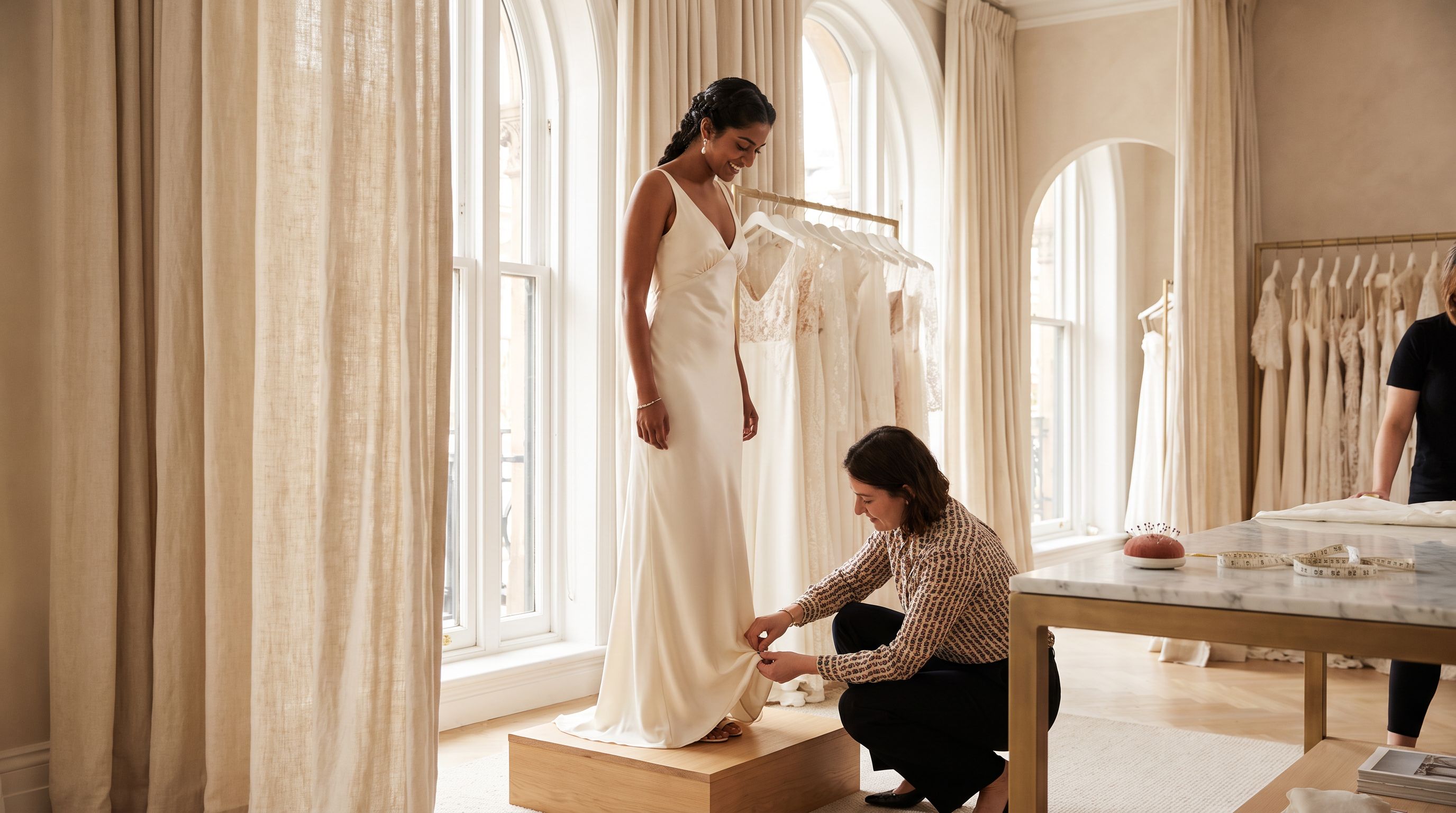
If you’ve spent an evening in wedding forums weighing a sample gown against having one made, you’ve probably seen the same two threads on repeat: someone who bought a stunning sample for a fraction of retail, then paid nearly as much again to make it fit — and someone else who had a dress made from scratch for less than a friend spent at a designer boutique.
Both stories are true. Which one becomes your story depends on a handful of very concrete factors: your measurements, your fabric, your timeline, and how much of the dress has to change.
What “sample sale” and “off the rack” actually mean
These phrases get used interchangeably, but they’re not quite the same thing.
Off the rack means you buy the physical dress in the shop and take it home that day (or shortly after). No 6–8 month production wait. The gown exists in one specific size, and everything after that is alterations.
A sample sale is a specific kind of off-the-rack event: a salon clears the try-on gowns people have been zipping in and out of for a season or two, usually at a steep discount. Sample gowns are typically shop-worn — a grubby hem, a stressed zipper, a few missing beads, occasional makeup marks. Most of that is fixable. Some of it isn’t.
Custom or made-to-measure means the gown is cut to your measurements from the start, with fittings built into the process. (If the terminology is fuzzy, our breakdown of semi-custom, made-to-measure, and bespoke sorts out what each label really promises.)
The number that matters is your landed cost
Here’s the arithmetic almost nobody does at a sample sale, when adrenaline is high and three other people are eyeing the same dress.
Figures are in US dollars and reflect US metro pricing; UK, AU, and EU markets differ, so adjust these brackets to your own city rather than treating them as benchmarks. A lace-and-tulle ballgown with a beaded bodice and three lined layers will sit at the top of every alteration range; an unlined crepe slip with a clean seam structure will sit near the bottom. Our full breakdown of what actually drives a custom gown’s price walks through fabric, construction, and labour line by line — the same drivers determine what an alterations bill looks like.
Here’s the comparison written out end to end, so you can copy the structure with your own numbers:
Lane A — sample gown: $1,400 sale price + $850 alterations (hem, take in bodice two sizes, bustle, cups) + $150 cleaning and pressing = $2,400 landed
Lane B — made-to-measure: $2,600 quote with pattern, toile, and three fittings included = $2,600 landed
A $1,200 gap on the price tag becomes a $200 gap once the work is priced in — and the second gown is cut to your body. Add a rush fee or a neckline change to Lane A and the order flips entirely.
The rule of thumb worth remembering: alterations are priced by how much of the dress has to be rebuilt, not by how many inches come off. Taking in a side seam is quick. Taking in a boned, lined, beaded bodice means unpicking the lining, resetting the boning, re-cutting the seam, re-beading the join, and reassembling — several hours of skilled work on one seam.
When a sample sale is genuinely the better buy
Say yes to the sample when most of these are true:
- The gown fits your largest measurement reasonably closely — you can always take a dress in, but there’s rarely more than an inch or two of seam allowance to let out.
- The changes needed are length, side seams, straps, and a bustle — the bread-and-butter alterations.
- The fabric is forgiving: crepe, mikado, satin, and plain tulle alter cleanly. Heavy all-over beading, placed lace, ruching, and pleated bodices do not.
- You love the dress as it is. Sample sales punish “I’ll just change the neckline and add sleeves.”
- You’re short on time. This is the sample sale’s real superpower — you leave with a dress in hand.
When having it made is the smarter money
Custom stops being the extravagant option and starts being the sensible one when the alterations list gets long.
Custom tends to win outright if you’re outside standard sample sizing, need genuine coverage or sleeves, are very petite or very tall, have an asymmetry or medical device to design around, or simply want something the market isn’t making this season.
A sample gown is a bargain right up until the moment a seamstress has to rebuild it. After that, you’re paying custom prices for someone else’s pattern.
What different budgets actually buy
At a sample sale, $2,000 might get you a designer gown that originally retailed for $5,000–$6,000 — genuinely excellent value if the fit work is modest. Budget realistically for alterations on top, and remember that a $2,000 sample needing $900 of reconstruction is a $2,900 dress.
In the custom lane, $2,000 is often achievable for a clean-lined, made-to-measure gown from an independent dressmaker — crepe, silk-blend satin, or a simple lace overlay, with restrained embellishment and fittings included. What it usually won’t buy is dense hand-beading, cathedral trains in silk, or couture-house construction. Ask makers what a budget like yours realistically supports; a good one will tell you plainly rather than saying yes and cutting corners later. (For a full side-by-side, see the real math on custom vs off-the-rack.)
Under $1,000 is a real lane too, and it’s rarely written about honestly. Preloved and resale platforms list gowns worn once, often already professionally cleaned, at a fraction of retail — the trade-off is that you’re buying sight-unseen and alterations still apply. Salons that are closing or clearing discontinued lines release ex-sample stock cheaply. And plenty of independent dressmakers will make to measure in cotton, linen, crepe, or a simple satin with minimal embellishment for less than a mid-range boutique gown, because in that price band you’re paying mostly for labour and a clean silhouette rather than fabric and beadwork. Simple is not a downgrade; it’s a design decision that photographs beautifully.
How to shop a sample sale without regret
-
Know your three numbers before you go
Bust, natural waist, and fullest hip, measured over the underwear you’ll actually wear. Bring the tape. Sample racks move fast, and eyeballing it is how people end up with a dress that can’t be let out. -
Inspect the gown in daylight, not spotlight
Check the underarm and hem for staining, the zipper for strain, the lace for pulls, and the beading for gaps. Ask what’s original and what’s already been repaired. -
Get an alterations estimate before you commit
Many salons have an in-house seamstress who can assess the work and give you a range on the spot. If they can’t or won’t, treat that as a real data point. -
Ask what's final
Sample sales are almost always non-refundable and non-exchangeable. Confirm it in writing so there’s no surprise. -
Do the landed-cost math on your phone
Sale price + alteration estimate + cleaning + rush fees. Then compare that number — not the sale price — to a custom quote.
Vetting the person who’ll actually do the work
In both lanes, the single biggest risk isn’t the dress — it’s whether the hands working on it are right for the job. Ask any alterations seamstress or dressmaker:
- Have you worked with beaded lace (or heavy satin, or pleated chiffon) before? Fabric-specific experience matters more than years in business.
- Can I see photos of fitted work on a body like mine? A portfolio of one size range tells you where their pattern skills are strongest.
- What’s included in the quote, and what’s charged hourly? Get the number of fittings, the bustle, and cups in writing.
- What happens if my size changes before the wedding? Weight shifts, pregnancy, and medication changes are normal. Ask how late a final fitting can be scheduled and what a re-fit costs.
The timeline factor people underestimate
A sample gown you carry home still needs two to three fittings, and good alterations departments book out. Aim to start three to four months before the wedding; six to eight weeks is doable but limits who can take you.
Made-to-measure typically wants four to eight months for a comfortable process — pattern, a muslin or toile, then two to four fittings — though many independent makers work faster for simpler designs, and some offer rush timelines for a fee. Our guide to how long a custom gown really takes maps the whole calendar.
The honest bottom line
Sample sales are brilliant if you fall near sample sizing, love a gown as it is, and need speed. Custom is brilliant for anyone whose body, taste, or coverage needs sit outside what the rack offers — and it’s frequently not the more expensive route once heavy alterations enter the picture.
The move that saves the most money isn’t picking a lane in advance. It’s pricing both properly, with the alteration estimate included, before whoever’s wearing it falls in love with anything.
Ready to bring your dream dress to life?
Tell us what you're picturing — style, timeline, and budget — and we'll connect you with custom dressmakers who can make it. Free, no obligation.
Get matched with a dressmakerRelated guides
Off the Rack Wedding Dresses: What It Means and Costs
What "off the rack" really means in bridal, how off-the-rack wedding dress costs compare to custom and made-to-measure, and how to set a realistic budget.
Read guide →
Chapel vs Cathedral Train: Length, Cost, and Bustles
Chapel vs cathedral train for a custom wedding dress: real length measurements, what extra train costs, bustle types and prices, and how to decide at your fitting.
Read guide →
Bridal Sizing vs Street Size: Why Gowns Run Small
Bridal sizing vs street size explained: why wedding dresses run 2–3 sizes small, what off-the-rack really means, alteration costs, and when made-to-measure wins.
Read guide →