 Custom
 Renting vs Buying vs Custom Wedding Dress: Cost Guide
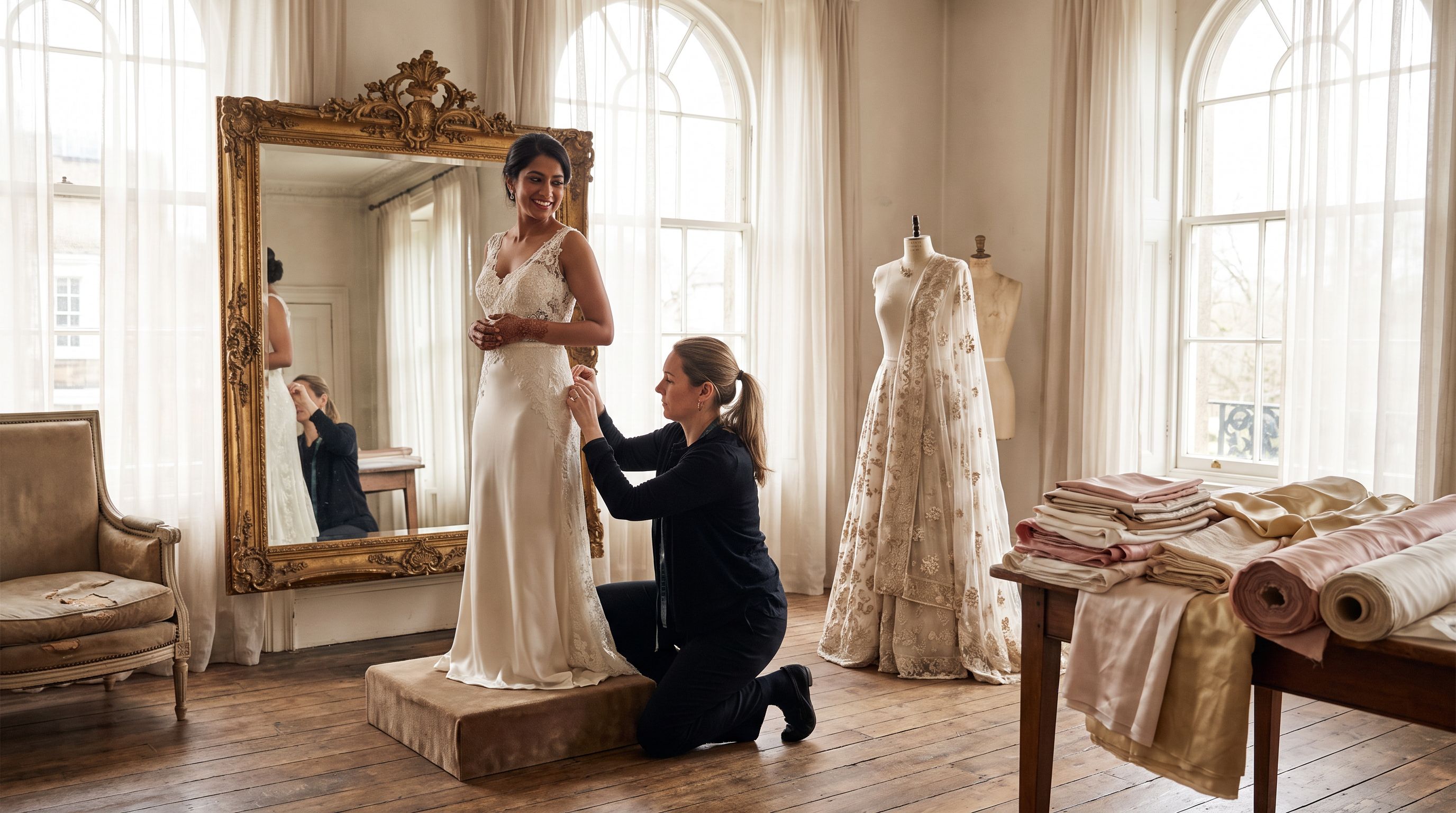
Wedding dress rental has grown up. What used to mean a limited rack of dated gowns now includes designer labels, mail-order try-ons, and reasonable turnaround. So the question we get now has changed too: not just “custom or off the rack?” but “should I just rent?”
The honest answer depends less on your budget than on your body and your expectations. Here’s how the three paths actually compare once you count every dollar and every fitting.
What renting really gets you — and what it doesn’t
A rental is a standard-size garment that must come back in sellable condition. That single sentence explains almost every rental rule.
You typically get the dress for a short window (often a handful of days), basic cleaning included, and sometimes an insurance add-on for minor damage. What you generally don’t get is permanent alteration. Most rental companies allow hemming with tape or a light, reversible take-in by their own approved tailor — not cutting, not reshaping a bodice, not moving a waist seam, not adding sleeves or a modesty panel.
Rental pricing spans a wide range depending on the label and the market.
Treat those as starting points to adapt, not benchmarks. A silk gown with hand-beading in a high-cost city sits far above the top of that custom range; a clean crepe slip from an emerging dressmaker can sit below the bottom.
Are off-the-rack dresses actually cheaper?
“Off the rack” in bridal means buying a gown that already exists — sometimes the literal sample off the shop floor, sometimes a stock-size gown ordered in and shipped. You choose from what’s made, in the sizes it’s made in.
On the price tag, yes, off-the-rack is usually cheaper than custom. In your final spreadsheet, sometimes not. Bridal gowns are cut for a fit model, and almost nobody is that fit model. Standard alterations — hem, side seams, bustle, straps — are one number. Reconstructive alterations are another entirely: reshaping a beaded bodice, re-cutting a lined skirt, adding sleeves, changing a neckline, or taking a gown down several sizes means taking the dress apart and rebuilding it. We walk through that math in detail in our guide to custom versus off-the-rack wedding dress cost.
The price tag is what you pay the shop. The budget is what you pay to actually wear the dress.
What custom typically costs, and what moves the number
When people ask how much a custom-made dress costs, they’re really asking what they’d be paying for. Roughly: fabric and trims, pattern drafting to your measurements, a muslin or toile, construction hours, and fittings — usually two to four, sometimes more.
The biggest cost drivers, in order of impact:
- Fabric. Silk mikado, double-faced satin, or good Italian crepe costs multiples of polyester equivalents, and full skirts eat yardage.
- Hand-work. Beading, appliqué placement, lace matching at seams, and hand-finished hems are hours, not materials.
- Structure. An internal corset, boning, or a built-in bra adds construction time — more so on a strapless or heavier gown.
- The maker’s experience and location. A seasoned atelier in a major city charges differently than an independent dressmaker in a smaller market.
- Number of fittings and how far you live. Remote clients add shipping and risk; local clients add travel time.
If you want a concrete sense of what different budgets buy, our breakdown of what $2k, $5k, and $10k gets you in custom is the clearest place to calibrate.
Setting a realistic dress budget
A realistic wedding dress budget is a range, not a number, and it should include everything that touches the gown: the dress itself, alterations or fittings, undergarments and shapewear, veil or headpiece, shoes for hemming, steaming or pressing before the day, and preservation afterward if you’re keeping it.
A quick way to decide
-
Measure honestly, in three places
Bust, natural waist, hips — plus hollow-to-hem in the shoes you’ll wear. Compare to a rental size chart. If you land in one size across the board, renting is genuinely on the table. If you span two or three, it isn’t. -
Name your non-negotiables
Sleeves, a covered back, a specific neckline, a fabric you love, pockets, a modesty panel, comfort for a long day of dancing. Add the cultural and ceremonial ones too: a red, gold, green or jewel-toned gown rather than ivory, a second outfit for the reception or a sangeet, a silhouette that works under a dupatta or with a hijab, kimono, or head covering. Rental racks almost never stock these, and off-the-rack bridal rarely does either — which is exactly where custom shifts from a luxury to the practical route. Count how many of your must-haves you can find on an existing rack. If the answer is zero or one, you have your answer. -
Decide if you want to keep it
Some people want the dress in a box forever; some genuinely don’t. There’s no wrong answer, but it changes the math entirely. -
Price all three, all-in
Get a rental quote with insurance, an off-the-rack quote plus a real alterations estimate from a seamstress who has seen the dress, and a custom quote from a maker who has seen your inspiration and measurements. Compare final numbers, not tags. -
Check your calendar
Rentals ship close to the date. Off-the-rack plus alterations usually needs roughly two to three months; custom commonly wants six to nine. Treat both like price ranges rather than fixed facts — heavily beaded or fully lined gowns take far longer to rework or build, and peak-season backlogs fill every good seamstress’s calendar months ahead. Many makers do take shorter timelines with a rush consideration.
What to ask before you commit
For a rental: what alterations are permitted, who performs them, what happens if the gown arrives not fitting, what the damage policy covers, and when it ships.
For off-the-rack: is this the sample or a new stock gown, what condition is it in, what size it is versus what you measure, and — before you sign — what an independent seamstress estimates for alterations.
For custom: how many fittings are included, whether a muslin is made before the real fabric is cut, what the payment schedule looks like, what happens if your body changes, whether fabric is included or billed separately, and how they handle a change of mind mid-process. A good maker answers all of that calmly, in writing, and shows you finished gowns on real clients — not just mood boards.
And it’s worth saying plainly who shouldn’t book a custom consultation. If your measurements land cleanly in one size, you want a simple silhouette with no coverage or cultural requirements, your timeline is tight, and you have no interest in keeping the dress afterward, renting or buying off the rack will serve you better — custom would add cost and calendar without adding much you’d feel on the day. But if your measurements span sizes, your must-have list keeps growing, or you’ve left a dozen appointments slightly deflated, talking to a dressmaker is simply the fastest way to learn what your vision would cost to build — which is the number you needed all along.
Ready to bring your dream dress to life?
Tell us what you're picturing — style, timeline, and budget — and we'll connect you with custom dressmakers who can make it. Free, no obligation.
Get matched with a dressmakerRelated guides
Off the Rack Wedding Dresses: What It Means and Costs
What "off the rack" really means in bridal, how off-the-rack wedding dress costs compare to custom and made-to-measure, and how to set a realistic budget.
Read guide →
Chapel vs Cathedral Train: Length, Cost, and Bustles
Chapel vs cathedral train for a custom wedding dress: real length measurements, what extra train costs, bustle types and prices, and how to decide at your fitting.
Read guide →
Bridal Sizing vs Street Size: Why Gowns Run Small
Bridal sizing vs street size explained: why wedding dresses run 2–3 sizes small, what off-the-rack really means, alteration costs, and when made-to-measure wins.
Read guide →