 Custom
 Hand-Painted Wedding Dresses: What Custom Artwork Costs
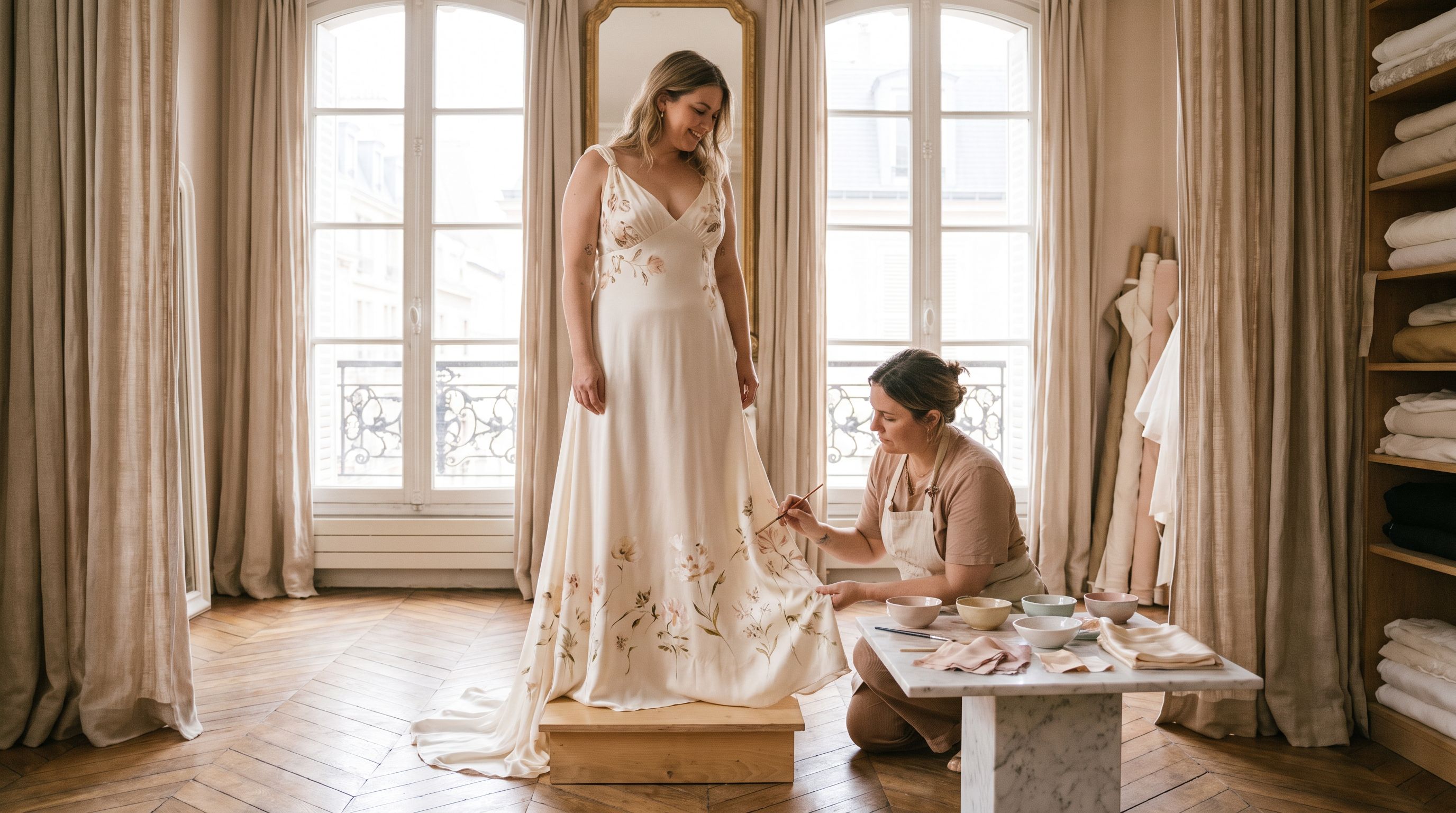
Why hand-work keeps coming up in consultations
Requests for hand-painted and hand-embroidered detail have grown noticeably in our studio conversations over the past few seasons. We can’t point to industry data proving it’s a universal trend — but we can tell you what clients say when they ask for it.
A beaded gown reads as expensive. A painted or embroidered one reads as mine. For anyone who has looked at a wall of near-identical strapless satin and felt nothing, artwork is often the missing piece — the thing that turns a beautiful garment into your garment.
None of this belongs only to a white gown and veil. The same techniques work on a suit, a set of separates, a jumpsuit, a reception second look, or a coat — a painted lining or an embroidered lapel carries just as much meaning. They also appear across cultural garments, with one important caveat: a lehenga, hanbok, áo dài, or cheongsam — particularly an heirloom piece, or one already carrying dense traditional embroidery — usually calls for an artisan trained in that specific tradition and textile, not a generalist painter. Ask directly whether a maker has worked in that idiom. A good one will answer honestly and often refer you onward.
The honest part: paint and thread behave very differently on different fabrics, and sequencing matters enormously. This is a place where a skilled maker earns their fee.
The three levels of personalization (and what each realistically costs)
The ranges below are illustrative starting points to help you estimate, not benchmarks. They vary widely with your region, the artist’s experience, and the hours involved. Always get a written quote for your specific design.
Most of what you’re paying for is time. Skilled hand-work is often billed at an artist or atelier hourly rate, and a single detailed floral motif can take an hour or more once you count testing, painting, drying, and heat-setting. Ask your maker to quote in hours, not vibes — “roughly 12–15 hours of painting at our studio rate” is a quote you can evaluate, adjust, and scale down if the number lands high.
The other drivers: how many colors (each added color often means another pass and another dry time), whether the design must match across a seam, whether beadwork or metallic thread is layered over the paint, and whether the fabric needs a test-and-discard round before anyone touches your actual garment.
Surface area is a driver too, and it’s worth saying plainly: the same design costs more on a longer or fuller skirt simply because there’s more ground to cover. Placement should always be planned on your own fitted pattern rather than copied from a straight-size inspiration photo — motifs stretch and distort over curves, bust darts, and princess seams, and a spray of flowers that sits beautifully on one body may need to be redrawn entirely to sit beautifully on yours.
Fabric decides almost everything
Natural fibers take paint best. Silk crepe, silk satin, silk habotai, and fine cotton organdy absorb pigment cleanly and stay soft after setting. Polyester and most synthetic satins resist dye and often need a fabric-specific medium that can leave the area slightly stiffer or shinier.
Texture matters too. A smooth, matte surface gives an artist control; heavy ribbing, crinkle, or a slubby weave will break up fine linework. If you’re still choosing between base fabrics, it’s worth reading our breakdown of crepe, satin, and mikado with painting in mind — the fabric that photographs best isn’t always the one that takes artwork best.
Embroidery has fewer restrictions but different ones: sheer fabrics show the back of the stitching, so a good maker will either design for that (deliberate, delicate, visible-back work) or float the motif on an appliquéd base. If you’re layering embroidery over lace, the lace pattern itself becomes part of the composition — our guide to Chantilly, Alençon, and Guipure lace is useful context for how much visual noise you’re working against.
Where the artwork should live
This is the single biggest lever on both cost and risk, and most clients don’t realize they have a choice.
How the process actually works
-
Bring reference images and be honest about scale
Show the maker what you love, but talk in specifics: how much should be covered, how visible from twenty feet away, how literal versus abstract. The gap between an inspiration image and a real garment is where most disappointment lives — our guide to working from an inspiration photo covers how to close it. -
Agree on a design on paper first
You should see a sketch or a paint-over of your own line drawing before anything is committed to fabric. Ask for placement, scale, and color palette in writing. -
Swatch test and approve
The maker tests on your actual fabric. You see it in daylight and in the light you’ll photograph in. Approve or adjust here — this is your last free revision. -
Decide the sequencing
Painting flat panels before construction gives cleaner results and lets the artist work at a table; painting a finished garment lets the design follow your real body and drape. Your maker will recommend one. Flat is usually cheaper; finished is usually more expressive. -
Artwork, setting, and a fitting after
Paint is heat-set or cured, embroidery is finished and pressed. Always schedule a fitting after the artwork — heavy stitching can subtly change how a panel hangs.
Build extra weeks into your timeline
Hand-work is not something you squeeze in at the end. As a studio rule of thumb — not an industry standard — we’d add roughly four to eight weeks to a standard custom schedule for meaningful artwork, and all-over painting can add months. Both figures move significantly depending on the individual artist’s queue, so treat them as a starting question rather than a promise.
The practical protection is contractual: ask for the artwork window to appear as its own dated milestone, separate from the garment’s construction and fitting schedule, so a backlog in one doesn’t quietly consume the other.
If you’re already inside a tight window, artwork on a veil or a detachable piece is the version that still fits; it can often be produced in parallel while the garment is being made. Our realistic custom gown timeline is a good sanity check before you commit to anything ambitious.
Adding artwork to a garment you already own
Yes, this is possible, and it’s often the smartest budget route: buy something clean and simple off the rack or at a sample sale, then commission the artwork separately.
Two cautions. First, check the fiber content before you fall in love with the idea — a polyester base limits what any artist can do. Second, artwork is usually irreversible, often reduces resale value, and complicates preservation. Painted silk generally can’t be conventionally dry-cleaned without risk; ask the artist exactly what cleaning is safe, in writing, and tell your preservation service before they touch it.
What to ask before you commit
A maker who is genuinely qualified will answer these easily: Have you painted or embroidered on this exact fabric before, and may I see it? Will you test on a swatch first? Is the artwork quoted by the hour or as a flat fee, and what happens if I change the design after approval? Is the work done before or after construction, and why? How should this be cleaned afterward?
Then the liability question — and here’s what a good answer looks like. Ask for a written scope that names placement, colors, and how many revision rounds are included, so “a few flowers” can’t drift into a full skirt. Ask, in writing, who replaces the fabric or the garment if a process you both approved at swatch stage fails on the finished piece; established artists typically carry that risk when the failure is theirs, and will say so plainly. And ask whether the artwork deposit is separate from the garment deposit, and whether it’s refundable up to the point the artist actually begins.
If those answers come back specific and calm, you’ve found the right person. If they come back vague, keep looking — hand-work is unforgiving, and experience is the whole product.
When you’re ready to talk it through with someone who does this for a living, a first consultation is typically free and no-obligation. Expect a review of your fabric or fiber content, a feasibility check on the design you have in mind, a placement discussion based on your measurements, and an estimate of the hand-work hours involved — enough to tell you whether your idea is a few-hundred-dollar detail or a several-thousand-dollar commission.
Ready to bring your dream dress to life?
Tell us what you're picturing — style, timeline, and budget — and we'll connect you with custom dressmakers who can make it. Free, no obligation.
Get matched with a dressmakerRelated guides
Custom Wedding Dress for Apple-Shaped Brides: Fit Guide
How a custom wedding dress solves fit for apple-shaped brides: the best silhouettes, internal support, fabrics, fittings, and realistic costs.
Read guide →
Custom Wedding Dress for a Small Bust: A Real Fit Guide
A custom wedding dress for a small bust: how bodices get cup-sized, strapless support without heavy padding, flattering necklines, and realistic cost ranges.
Read guide →
Custom Winter Wedding Dress: Fabric, Sleeves, Warmth
How to design a custom winter wedding dress that's genuinely warm: the best fabrics, sleeve and lining choices, capes, realistic costs, and timeline tips.
Read guide →