 Custom
 Custom Wedding Dresses for Tall and Long-Torso Brides
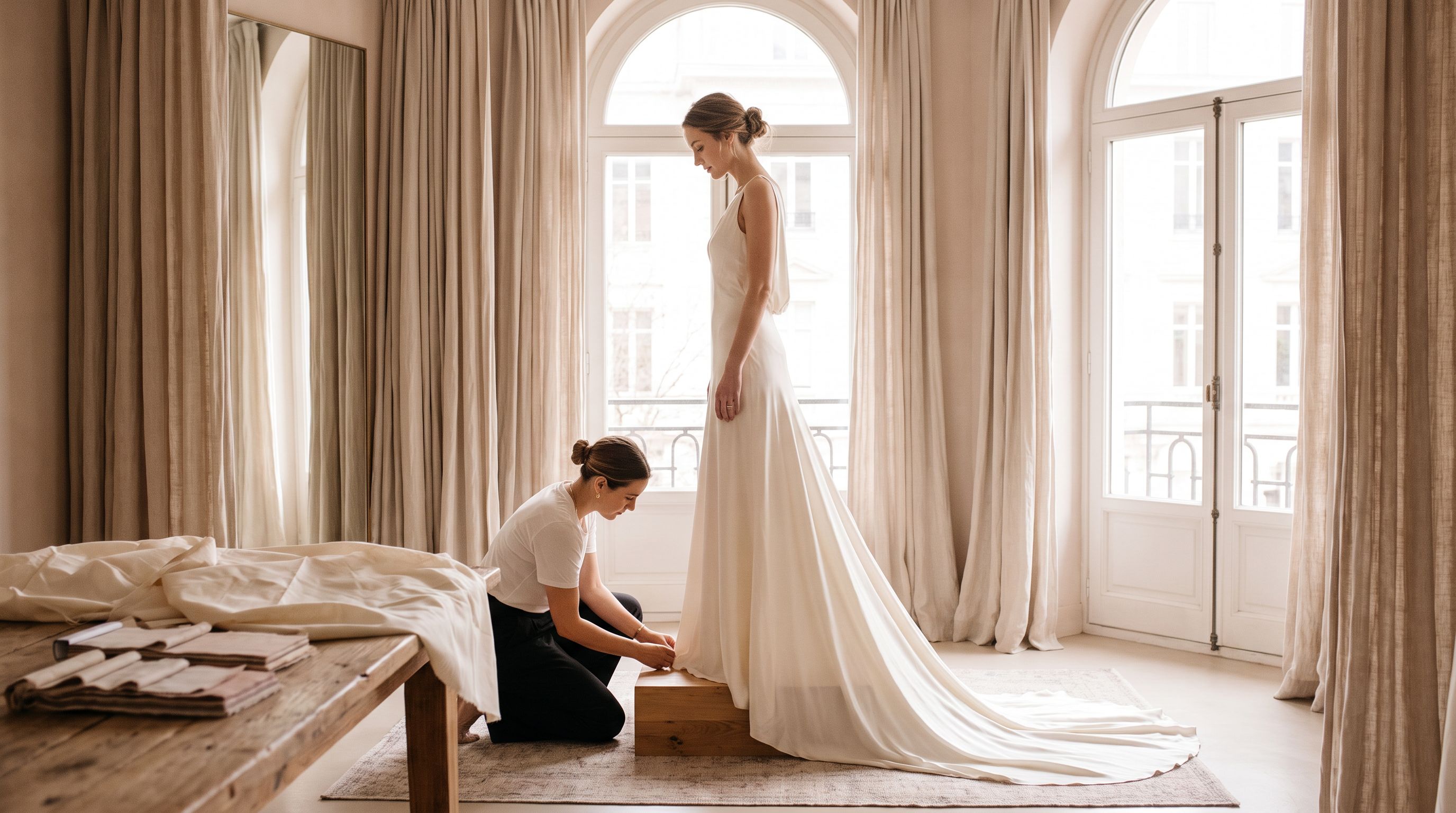
Why bridal samples fight tall bodies
If you’ve tried on gowns and left feeling vaguely defeated — the hem floating above your shoes, the bodice ending somewhere north of your natural waist, the sleeves stopping at your forearm — nothing is wrong with your body. You’re just meeting a pattern that was never drafted for it. (Everything here applies equally to tall brides, grooms, and nonbinary folks commissioning a gown; the fit principles don’t care about gender.)
Bridal patterns are graded from a fit model. Sizing up or down widens and narrows a garment, but grading adds relatively little vertical length. So a size 20 and a size 6 from the same designer may have waist seams sitting nearly the same distance from the shoulder. Height and torso length live in a different set of measurements entirely:
- Hollow-to-hem — the notch at the base of your throat to the floor, in your wedding shoes. This is the number that determines whether a gown skims the floor or floats.
- Shoulder-to-waist (front and back) — where the bodice ends and the skirt begins.
- Waist-to-hip and rise — how far the hip curve sits from the waist seam, which decides whether a fitted skirt flares in the right place.
- Arm length and armhole depth — long-limbed wearers often find sleeves short and armholes shallow, which pulls the whole bodice down.
And while we say “bridal” throughout, the same vertical-measurement logic governs a lehenga, a cheongsam or qipao, a hanbok, an áo dài, or any other floor-length formalwear — the seams still have to land where your body’s lines are.
What “extra length” actually buys you off the rack
Most bridal designers offer an extra-length option — commonly a few inches added to the skirt, ordered at the time of purchase and priced as a surcharge. It’s a genuinely useful service, and for many people it’s the difference between a gown that works and one that doesn’t.
But be clear-eyed about what it does. In most houses, added length is inserted below the waist. It solves the hem. It does not lower the waist seam, deepen the armhole, lengthen the bodice, or extend a sleeve.
Here’s a concrete way to check rather than assume: ask your consultant to pull the designer’s spec sheet and ask, “Is the added length inserted at the skirt panel, or distributed through the bodice as well?” The tell is usually visible in the numbers — extra length appears as a single figure applied to the skirt or the hollow-to-hem total, with no matching change to shoulder-to-waist, sleeve length, or armhole depth. If those bodice measurements are unchanged, your proportion issues above the waist will still be there when the gown arrives.
A second thing to plan for: extra length is typically a made-to-order choice, which means production lead times, not a rack pickup. And if the gown has a horizontal lace border, tiered ruffles, or a beaded hem motif, adding inches may shift the design in ways you’ll want to see rendered before you commit.
Where a hem finishes and a rebuild begins
A good alterations specialist can do remarkable things. But there’s a real boundary, and knowing it before you fall in love with a sample saves heartbreak.
We go deeper on that boundary in our guide to where wedding dress alterations stop and custom begins. The short version: if two or more of your fit issues sit above the waist, you’re often paying alteration money to get a compromise instead of paying custom money to get a fit.
The quiet advantage of made-to-measure at height
Here’s the encouraging part. Once a pattern is drafted to your measurements, height stops being a problem to solve and becomes a design asset.
Proportion gets designed on purpose. A skilled maker will place the waist seam where your natural waist actually is, then set the skirt fullness to flatter your leg length rather than fight it. Empire and drop-waist lines — which often look mysteriously off on tall frames in samples — can be tuned to your exact torso.
Train and veil scale correctly. A chapel train that reads elegant at 5’4” can look stubby at 6’0”. Custom lets you extend the sweep so the proportion holds in photographs.
Vertical details land where you want them. A V-neck cut to the right depth, a lace motif placed to travel down the body rather than being chopped by a side seam, princess seams drafted to your actual curve line — these are the details that make a gown look like it grew on you.
Fabric choice matters more at length. More vertical distance means more fabric weight hanging from the shoulders and waist. Structured fabrics like mikado hold a clean column beautifully; fluid crepe skims and elongates; heavy beaded lace needs internal support so it doesn’t drag the bodice down. Our fabric comparison guide walks through how each behaves.
A gown that fits a tall body isn’t a short gown with inches added at the bottom. It’s the same design, redrawn on a longer set of lines.
What the process looks like, step by step
-
Consultation and design conversation
You bring inspiration images, talk silhouette, venue, budget, and comfort. Say the word “tall” out loud and ask directly how often they draft for long torsos or long limbs. A confident maker will answer with specifics. -
Full measurement session
Expect 20 to 30-plus measurements, including hollow-to-hem taken in your actual wedding shoes, shoulder-to-waist front and back, arm length, and armhole depth. Bring the shoes and the undergarments you plan to wear. -
Toile or muslin fitting
A test garment in inexpensive fabric. At height this is the single most valuable appointment — it’s where the waist seam, hem break, and strap length get proven before real silk is cut. -
Construction and mid-process fittings
Usually two to four fittings as the gown is built, with the hem and any beading finished near the end so your measurements are current. -
Final fitting and steam
Bustle points set to your proportion, hem checked in shoes, and a walk-and-sit rehearsal in the room.
Plan on roughly six to nine months for a comfortable custom timeline, with shorter turnarounds sometimes possible at a rush premium — our custom gown timeline guide breaks down what fits into each window.
Questions worth asking before you commit
- May I see photos of gowns you’ve made for clients around my height?
- Where will you place the waist seam on me, and why?
- How many fittings are included, and is the toile part of the quote?
- How will the fabric and any lace border behave at this length?
- What’s your policy if my measurements change before the wedding?
A maker who answers these thoughtfully — and who measures you carefully rather than eyeballing a size — is showing you their standard of care. Our full checklist for vetting a dressmaker covers contracts, deposits, and red flags.
Deciding what’s right for you
If your only issue is hem length and you love a sample, extra length plus a skilled alterations specialist is often the smart, economical path. If your fit problems stack — short bodice, high waist seam, short sleeves, shallow armhole, plus hem — the money you’d spend chasing all of those in alterations frequently lands close to a made-to-measure quote, without ever giving you the proportion you actually wanted.
Those aren’t the only two doors, though, and a smaller budget doesn’t lock you out of good proportion. Secondhand and sample-sale gowns are often worth a look precisely because older or ex-display stock sometimes carries generous hem allowance — ask the seller to measure the folded-up hem before you buy. An independent seamstress working from a commercial pattern can cut a simple silhouette to your measurements for considerably less than a bridal atelier, since you’re paying for labor rather than design development. And separates are the quiet hack for long torsos: buying or commissioning a bodice and a skirt independently sidesteps the waist-seam problem entirely, because you get to decide where the two meet.
The most useful next step is a conversation with someone who drafts patterns for a living. A good maker will tell you honestly if your inspiration gown could simply be ordered long — and that honesty is exactly the signal you’re looking for.
Ready to bring your dream dress to life?
Tell us what you're picturing — style, timeline, and budget — and we'll connect you with custom dressmakers who can make it. Free, no obligation.
Get matched with a dressmakerRelated guides
Off the Rack Wedding Dresses: What It Means and Costs
What "off the rack" really means in bridal, how off-the-rack wedding dress costs compare to custom and made-to-measure, and how to set a realistic budget.
Read guide →
Chapel vs Cathedral Train: Length, Cost, and Bustles
Chapel vs cathedral train for a custom wedding dress: real length measurements, what extra train costs, bustle types and prices, and how to decide at your fitting.
Read guide →
Bridal Sizing vs Street Size: Why Gowns Run Small
Bridal sizing vs street size explained: why wedding dresses run 2–3 sizes small, what off-the-rack really means, alteration costs, and when made-to-measure wins.
Read guide →