 Custom
 Custom Wedding Dress for a Second Wedding: A Real Guide
Why this dress is a different decision — not a smaller one
There’s an old, tired script about second weddings: keep it quiet, keep it short, don’t make a fuss. Please ignore it. The people we see planning a second marriage or a ten-, twenty-, thirty-year vow renewal are usually clearer, calmer and far more decisive than first-time shoppers — and that’s exactly the client a custom dressmaker loves.
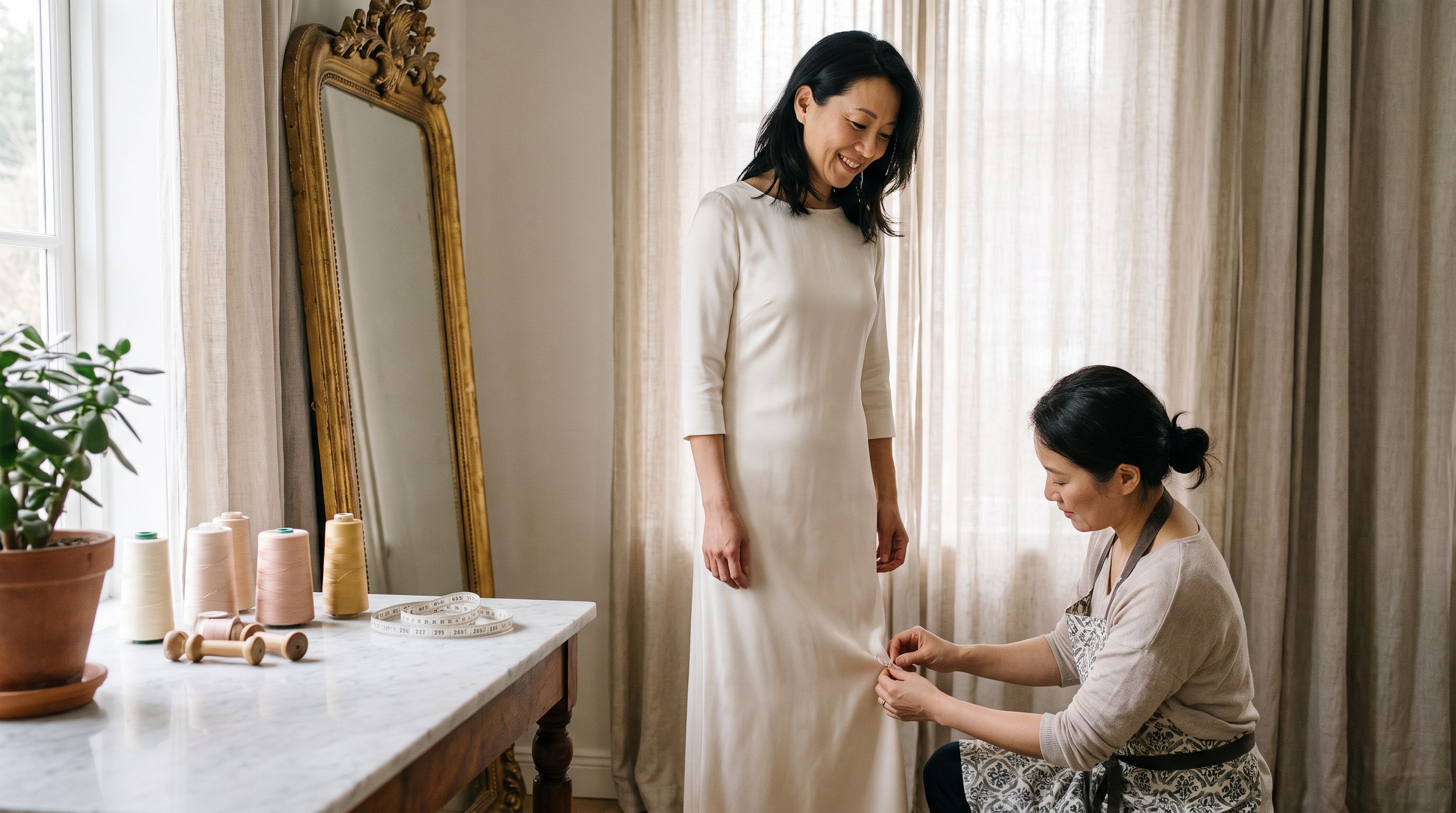
What’s genuinely different is the brief. You often want something you’ll feel like yourself in rather than a costume; you may want sleeves or more coverage than the racks offer; you might be marrying in a garden, a courthouse, a restaurant, or on a beach with your adult children in the front row. Most bridal stock is cut from strapless, sample-size blocks in a narrow ivory range. Custom is cut to whatever you actually asked for.
The silhouettes and details that come up again and again
Certain requests repeat in this category, and they’re worth knowing because they steer both design and cost:
- Sleeves. Three-quarter, long fitted, or a soft bishop sleeve. This is the single most common ask, and one of the hardest things to find in stock — most gowns are strapless-based, and adding sleeves to a strapless bodice is real structural work.
- Modesty and religious requirements. Fully lined sleeves so lace doesn’t read as sheer, opaque underlayers instead of nude illusion, raised necklines, covered backs, and a ceremony overlay or jacket that lifts off for the reception. These are routine commissions, not special favors — but a lined sleeve is effectively two sleeves, and a removable overlay is a second garment, so both add yardage and usually one extra fitting. Raise them at the first consultation rather than at the muslin stage.
- Non-white and culturally specific gowns, and second outfits. Red, gold or jewel tones, a sari- or lehenga-inspired drape, a hanbok- or cheongsam-influenced line, or a Western gown for the ceremony plus a change for the reception. Two looks means two patterns, two muslins and roughly double the fabric, so build an extra four to six weeks into the timeline.
- Column, soft A-line, or bias-cut slip shapes in crepe or heavy satin. Quietly dramatic, easy to move in, and beautiful in photographs at any age or size.
- Coverage where you want it, openness where you don’t. A high back with a low front, or the reverse. Custom lets you place the exposure deliberately.
- Color. Champagne, oyster, blush, pale blue, deep ivory, black. A dressmaker can source almost any shade; retail carries what sells.
- Tea-length and midi hems for civil ceremonies — with the caveat that a shorter dress is not automatically a cheaper dress. The construction, lining and finishing are the same; you’re only saving on fabric.
- Built-in support so you’re not hunting for a strapless bra that works. If that’s a priority, read our breakdown of corset construction versus a built-in bra before your consultation.
What a made-to-measure gown realistically costs
There is no honest single number here, and anyone quoting one is guessing. What we can give you are ranges that behave predictably once you understand the drivers.
The price drivers are consistent no matter where you live: fabric cost per meter (or yard) and how many meters the design eats; hand labor (beading, embroidery, hand-rolled hems, boning and internal corsetry); number of fittings; the maker’s experience and overhead; and your local cost of living — a dressmaker in a major coastal city charges differently from one in a small town, and both can be excellent. For a fuller breakdown of what each tier buys you, our guide to what $2k, $5k and $10k actually get you is the most useful place to start.
Is off-the-rack actually cheaper?
Often, yes — especially if you can wear a sample size and love it as-is. “Off-the-rack” in bridal means a finished gown you buy from stock and take home, rather than one ordered in and made for you. Sample sales, trunk clearances and non-bridal evening wear can produce genuinely brilliant value.
The catch is the all-in number. A stock gown that fits your bust rarely fits your waist, hips and height at once, and alterations for a bridal gown — hem with lace reapplication, side seams, strap and cup adjustment — are frequently a four-figure line item on their own. Ask for a change the dress wasn’t designed for, like sleeves or a raised neckline, and you’re paying a seamstress to redesign someone else’s pattern.
If you’re weighing the two carefully, our real math on custom versus off-the-rack cost walks through the arithmetic with alterations included, which is the comparison most shopping advice quietly skips.
The timeline, honestly
-
Consultation (1–2 hours)
You bring images, fabric swatches you like, shoes if you have them, and your real constraints — venue, weather, budget, what you refuse to wear. A good maker sketches, talks you out of at least one thing, and quotes in writing. -
Measurements and pattern drafting
Twenty-plus measurements, taken over the undergarments you’ll actually wear. The pattern is drafted or blocked to you rather than to a size chart. -
Muslin fitting
A cotton mock-up of the gown. This is where necklines get raised, sleeves get narrowed, and you discover the shape you swore you wanted isn’t the one. Cheap to change here; expensive to change in silk. -
Construction and 2–4 fittings
Cutting into your real fabric, then progressive fittings — structure first, then hem and finishing, then final press. -
Final fitting, 2–4 weeks out
Hem set to your shoes, bustle points marked, and someone teaches your person how to do up the back.
Six to nine months is comfortable. Three to four is very often possible for a simpler design, particularly outside peak season — see how long a custom gown really takes for what compresses safely and what doesn’t. Heavy hand-beading and imported lace are the two things that don’t rush.
Where to start this week
Gather eight to twelve images — including things you dislike, which are more informative than the ones you love. Note your venue, the month, and how much you plan to dance. Then book one or two consultations; most makers offer an initial conversation at no cost and no obligation, and an hour with a good dressmaker will tell you more about what’s possible at your budget than another month of scrolling. Bring your questions and your doubts with you.
Ready to bring your dream dress to life?
Tell us what you're picturing — style, timeline, and budget — and we'll connect you with custom dressmakers who can make it. Free, no obligation.
Get matched with a dressmakerRelated guides
Off the Rack Wedding Dresses: What It Means and Costs
What "off the rack" really means in bridal, how off-the-rack wedding dress costs compare to custom and made-to-measure, and how to set a realistic budget.
Read guide →
Chapel vs Cathedral Train: Length, Cost, and Bustles
Chapel vs cathedral train for a custom wedding dress: real length measurements, what extra train costs, bustle types and prices, and how to decide at your fitting.
Read guide →
Bridal Sizing vs Street Size: Why Gowns Run Small
Bridal sizing vs street size explained: why wedding dresses run 2–3 sizes small, what off-the-rack really means, alteration costs, and when made-to-measure wins.
Read guide →