 Custom
 Custom Wedding Dress for Apple-Shaped Brides: Fit Guide
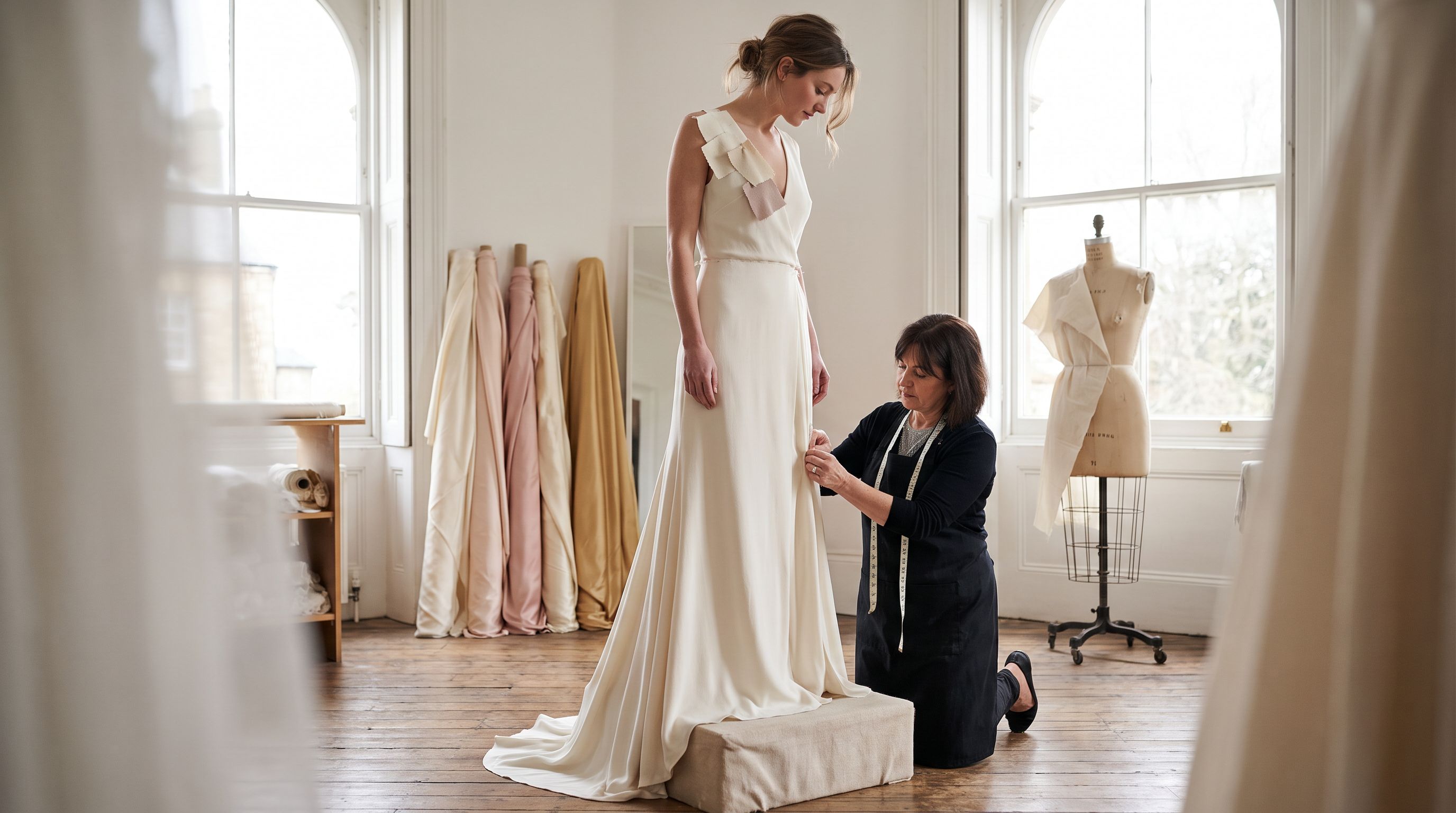
What “apple-shaped” actually looks like on a real body
Body-shape labels are blunt instruments, but they’re useful shorthand with a dressmaker. If the term fits you, you probably recognise this: your bust, waist and hip measurements sit closer together than the fashion industry assumes, your midsection is the fullest part of your torso, and your arms and legs are proportionally slimmer. Many people also have a full bust directly above a fuller middle, so the gown has two jobs at once — lift and support up top, skim and smooth below.
What matters more than the label: a good maker doesn’t design for “apple.” They design for your measurements, including the ones nobody in a salon takes — the height of your natural waist, the front-to-back depth of your ribcage, and how your posture shifts when you breathe deeply in a strapless bodice.
Why sample gowns fight you (and it isn’t your body’s fault)
A standard bridal pattern assumes a dramatic waist-to-hip difference. When yours is smaller, the gown grips at the widest point of your midsection, floats away at the underbust, rides up as you move, and pulls a horizontal crease across the tummy that no steaming will fix.
Then there’s sizing. Bridal sizes run small and are usually chosen off your single largest measurement — often the bust or waist here — so you’re ordered several sizes up and told it will “all be taken in,” pushing seams and lace motifs where they were never engineered to sit. Our breakdown of why bridal sizing runs so different from street size explains what’s happening on that order form.
None of this is bride-specific, either. Non-binary and gender-diverse people get married too, and the same drafting principles apply whether you’re commissioning a coloured gown, a lehenga, an áo dài, a fully sleeved modest design, or something quietly elegant for a second wedding or a registry-office morning.
Silhouettes that tend to work well — and how a maker adapts them
There’s no forbidden list, only constructions that need more engineering on your frame than others.
A-line with a raised, softened waist. The workhorse. Lifting the waist seam an inch or two and releasing the skirt from there creates a long vertical line. If you’d prefer less visual width at the hip, ask for a gradual flare rather than a sharp one.
Empire and modified empire. Lovely in soft crepe or silk chiffon, and genuinely comfortable. The risk is a shapeless tent effect if the bodice isn’t structured and the skirt is cut too full; the fix is real shaping through the bodice (princess seams, a V or square neckline) and a skirt that falls close to the body.
Soft sheath with internal shaping. Works far better than people expect if built over a proper foundation. Stretch crepe with a hidden power-mesh lining holds and smooths; unlined satin maps every ripple.
Ballgown with an elongated bodice. The bodice length is everything — extending it just below the natural waist and shaping it into a soft V lengthens the whole line.
Draping, ruching, and asymmetry. Diagonal gathers across the midsection are a classic couture move: they break up the surface and ease the transition between bodice and skirt. Done well, they read as deliberate design.
The answer to a fuller midsection isn’t a tighter dress. It’s a longer line, real internal support, and fabric that touches the body only where you choose.
Support is the real secret — and it’s invisible
This is where custom earns its keep. A gown built for you can include a corseted inner bodice with a waist stay, boning placed along your seam lines, moulded cups, and power mesh through the midsection. That structure means the outer fabric doesn’t have to grip to stay up — which is exactly what stops the cling.
With a full bust, a well-built corselette also creates space between bust and midsection, instantly lengthening the torso. Our guide to corset bodices versus built-in bra cups covers which system suits which bust size and neckline.
Fabric choices that skim instead of cling
Fabric weight does more work than colour or cut. Heavier, body-skimming fabrics — stretch crepe, mikado, duchesse satin — hold their own shape and glide. Thin jersey or unstructured charmeuse reveals everything beneath. If you want something light and airy, the answer is layers: a structured underlayer with tulle, organza or chiffon floating above. Fabric is also the largest single variable in your quote, so raise it early.
Necklines, sleeves, and where the eye lands
Open necklines — V, square, a wider-set sweetheart, portrait — expose the collarbone and create vertical line. A deep V with a modesty panel gives that length with more coverage. If you’d like your arms covered, ask for sleeves cut generously through the bicep and fitted at the wrist; tight sleeves ending mid-bicep are the least comfortable option. Illusion, flutter and detachable off-shoulder sleeves are all straightforward to build to your arm measurement.
What a custom gown realistically costs
Averages mislead, because two gowns at the same price can be entirely different objects. Understand the drivers instead, then estimate your own number.
The biggest drivers here: internal structure (a full corselette adds labour), fabric yardage and quality, embellishment, train length, and your maker’s experience and city. Budget for a veil, undergarments, travel to fittings and a bustle too.
If those figures feel out of reach, there are real routes below them. Independent home-based dressmakers often charge considerably less than studios with shopfronts. Final-year students at sewing schools and graduate designers take commissions to build portfolios. Remaking an heirloom gown — recutting the bodice, reusing the lace — can be far cheaper than starting from new fabric. And a simple made-to-measure crepe dress with no beading, no train and clean seams is one of the most elegant things you can wear, at a fraction of the cost of surface decoration.
So is off-the-rack cheaper? Sometimes, especially at sample sales. The honest comparison is the finished, fitted price — gown plus alterations plus compromises. Our guide to what alterations can and can’t fix does that maths in full.
What the custom process looks like
-
Consultation
Bring inspiration photos and your non-negotiables: coverage, sitting comfortably at dinner, venue temperature. A good maker discusses your body candidly and without judgement. -
Measurements and pattern draft
Expect 15–25 measurements — torso length, underbust, high hip — not just the standard three, taken in fitted clothing or your wedding undergarments. -
The toile (muslin) fitting
A test garment in cheap fabric, fitted and marked on your body. Waist placement, bust apex and strap position are decided here. For apple-shaped frames this fitting is the whole ballgame — don’t book a maker who won’t do one. -
Fittings in the real fabric
Usually two to three. Bring your shoes and undergarments every time. Move, sit, raise your arms, and say out loud if anything grips. -
Final fitting and bustle
Two to four weeks out, with the bustle pinned and someone taught how to fasten it.
Most timelines run 6–9 months comfortably; 4–5 months is workable with many makers, and rush work under 12 weeks limits fabric sourcing and usually carries a fee.
What to ask before you commit
- “Can I see gowns you’ve made for bodies shaped like mine?” — portfolio range matters more than follower count.
- “Do you draft a new pattern or adapt an existing block?” — both are valid; the answer tells you what you’re paying for.
- “Is a toile included, and how many fittings are in the quote?”
- “What internal support will this bodice have?”
- “What does the contract say about deposits, payment schedule and delivery date?”
If you’ve left bridal appointments feeling like the problem was you, it wasn’t — it was the pattern. Whatever you decide next, the move is the same: take a full set of your own measurements, ask where the waist seam will sit, and ask what’s holding the bodice up. Whether you commission something from scratch, order made-to-measure, rework a sample with a skilled alterations specialist, or remake a gown you already own, those three questions will tell you more about how a dress will feel on the day than any size label ever could.
Ready to bring your dream dress to life?
Tell us what you're picturing — style, timeline, and budget — and we'll connect you with custom dressmakers who can make it. Free, no obligation.
Get matched with a dressmakerRelated guides
Custom Wedding Dress for a Small Bust: A Real Fit Guide
A custom wedding dress for a small bust: how bodices get cup-sized, strapless support without heavy padding, flattering necklines, and realistic cost ranges.
Read guide →
Custom Winter Wedding Dress: Fabric, Sleeves, Warmth
How to design a custom winter wedding dress that's genuinely warm: the best fabrics, sleeve and lining choices, capes, realistic costs, and timeline tips.
Read guide →
Custom Wedding Dress for Pear-Shaped Brides: Fit Guide
A custom wedding dress for pear-shaped brides solves the hip-to-waist gap standard bridal sizing can't. Silhouettes, fabrics, fittings, and real cost ranges.
Read guide →