 Custom
 Qipao vs Kua: Chinese Wedding Dress Guide
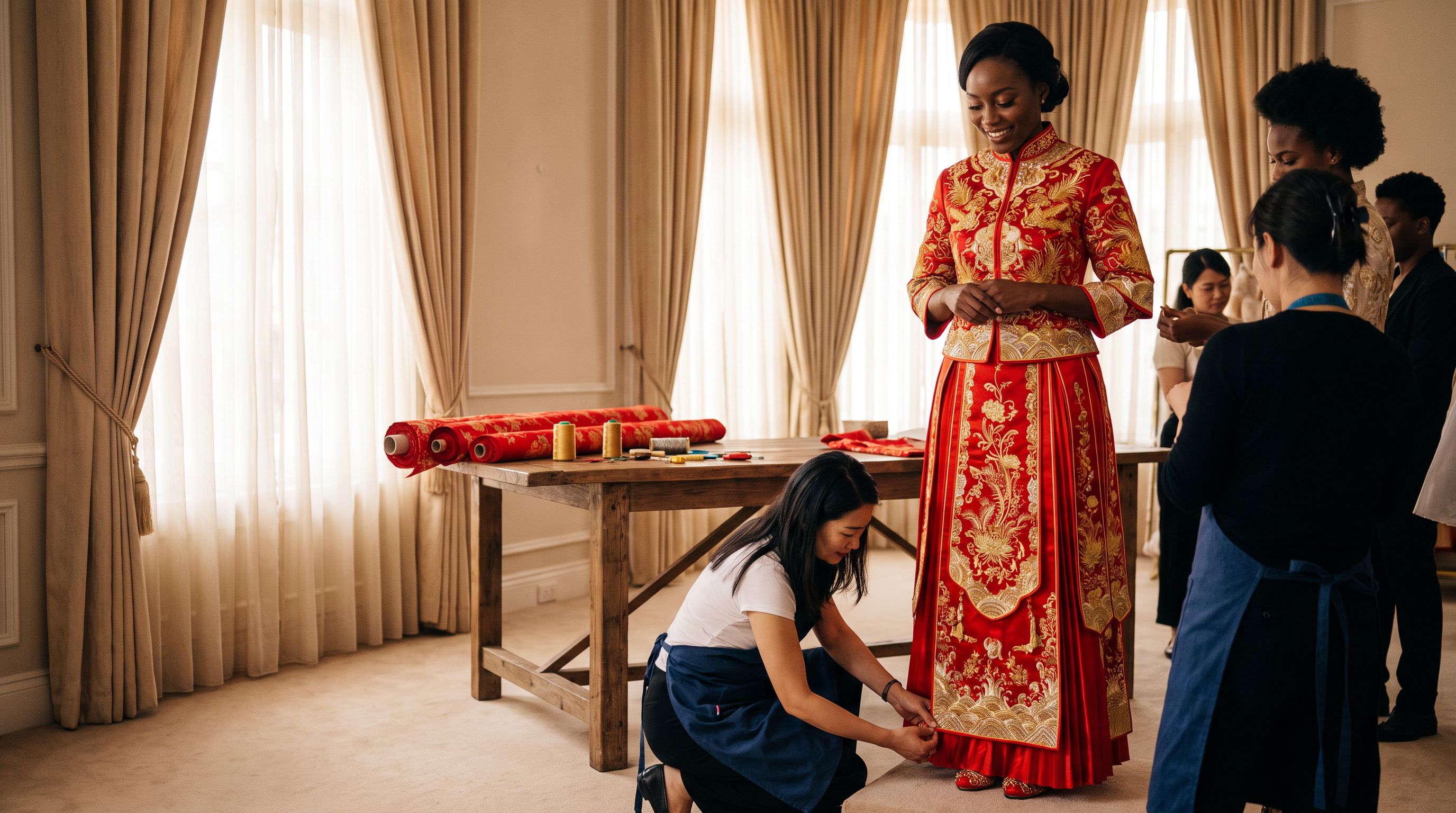
If your wedding includes a Chinese tea ceremony, a banquet, or both, you’re likely juggling two or three outfits with very little clear pricing information. Bridal shops can tell you about white gowns. Far fewer can explain the difference between machine- and hand-embroidered gold thread, or why one kua costs as much as a used car.
Here’s the practical version — what each garment is, what drives the price, and how to commission one well.
Qipao, kua, xiuhefu: what you’re actually choosing between
The qipao (also called cheongsam) is the silhouette most people picture: a fitted one-piece dress with a stand collar, an asymmetric front opening fastened with pankou (hand-knotted frog closures), and side slits. For weddings it’s usually red — silk satin, brocade, or jacquard — often embroidered with phoenixes, peonies, or a dragon-and-phoenix pair.
The kua (裙褂, often written qun kwa) is a Cantonese tradition: a separate jacket and skirt worked in raised gold and silver metallic thread over red silk. Workshops grade a kua by how much of the base fabric the embroidery covers, and the Cantonese ladder is worth learning before you price-shop: siu ng fuk (小五福, roughly 30% coverage), jung ng fuk (中五福, around 50%), dai ng fuk (大五福, 70% and up), then kwa hau (褂后) and, at the top, kwa wong (褂皇), where the gold is so dense the red barely shows. Most of the price bands below correspond to the siu ng fuk through dai ng fuk tiers; hand-worked kwa hau and kwa wong pieces begin roughly where those bands end and climb steeply from there. Denser gold also means heavier and stiffer.
Xiuhefu (秀禾服) is a third option: a two-piece set with a straighter, less body-conscious jacket and a wrap or pleated skirt, usually in colorful floral embroidery rather than all-over gold. Some couples now choose Ming-style hanfu for a more historically formal look.
There’s no single correct choice. Cantonese families often expect a kua; many northern and Southeast Asian Chinese families are perfectly happy with a red qipao. Ask both sets of parents early — it’s a conversation, not a rule.
Best if: you want something you can move, sit, and eat in; you love a sleek line; you may wear it again at an anniversary or someone else’s banquet.
Fit demands: very high — close-fitting through bust, waist, and hip, so measurements and a toile matter enormously.
Weight: light to moderate.
Typical lead time: about 3–5 months made-to-measure; longer with hand embroidery.
Best if: tradition is central, you want full ceremonial impact, and the tea ceremony is the emotional centerpiece of your day.
Fit demands: moderate — the jacket is cut with ease, which is forgiving across many body shapes.
Weight: moderate to genuinely heavy at high embroidery grades.
Typical lead time: 6–12 months for hand-embroidered pieces; panels are worked before construction.
What a custom qipao or kua actually costs
Treat every number below as a starting frame, not a quote. Price varies enormously by where the garment is made, whether embroidery is machine or hand, and the fiber content of both cloth and thread.
The cost drivers, in rough order of impact:
- Hand vs machine embroidery. A densely hand-worked kua can represent hundreds of hours of skilled needlework. Machine embroidery gives a flatter, more uniform surface at a fraction of the cost — and photographs perfectly well.
- Coverage grade. Moving from siu ng fuk to near-total coverage isn’t a 3× jump in labor; it’s steeper.
- Thread and fabric. Real gold- or silver-wrapped thread, heavy mulberry silk satin, and woven jacquard cost multiples of synthetic alternatives.
- Where it’s made. Labor rates differ hugely by region, which is why similar-looking pieces carry wildly different tags.
- Customization depth. A stock pattern resized to you costs far less than original artwork or motifs incorporating your names.
- Rush. Compressing an embroidery schedule means paying for more hands, not faster hands.
Why the fit conversation is different here
A fitted qipao shows every line of the pattern work. A maker who takes eight measurements and calls it done will give you a dress that pulls across the bust or gapes at the back neck. Good makers measure far more: bust, underbust, waist, high hip, full hip, shoulder-to-bust point, nape-to-waist front and back, bicep, armhole depth, collar circumference, finished length, and slit height. They’ll also ask whether you’ll serve tea kneeling or standing, and whether you need to lift your arms to pour.
If you have a significant bust-to-waist difference, a soft tummy, a sway back, broad shoulders, or you’re plus-size, a qipao can be genuinely beautiful — but it must be drafted with real bust darts or princess shaping rather than side-seam-only shaping. Our guides to custom gowns for a full bust and small waist and custom wedding dresses for plus-size and curvy brides translate directly to qipao bodice patterning.
A kua is friendlier: the jacket carries ease, so the critical points are shoulder width, sleeve length, jacket length relative to your torso, and where the skirt sits. Petite wearers should ask how motifs will be scaled — a border designed for a 40-inch skirt reads very differently at 34 inches.
Three situations deserve explicit conversation:
- Wheelchair users and seated ceremonies. Ask for a jacket drafted seated, so the back doesn’t ride up and bunch, and a skirt hemmed to seated length so it doesn’t pool, catch in wheels, or drag at the footplates. A slightly shorter jacket front also keeps embroidery out of your lap.
- Pregnancy or anticipated weight change. Ask the maker to build ease into the side seams and a wider seam allowance at the waistband, or to use a tie/lacing closure rather than a fixed band. Most makers want final adjustments 3–4 weeks before the date; embroidered kua skirts need longer, because gold-worked panels can be taken in but essentially never let out.
- Chest binding or masc-presenting wearers. A kua jacket, xiuhefu, or Ming-style hanfu can be cut with minimal bust shaping and a straighter chest line, and a qipao can be drafted with a flatter front and a higher collar. Say this at the consultation, before any pattern is drafted.
How the commissioning process usually runs
-
Decide the garment and the grade
Settle qipao vs kua vs xiuhefu, and for a kua, which coverage tier. This single decision sets both budget and timeline. -
Consult and measure
Expect questions about ceremony format, venue temperature, how long you’ll wear it, and whether you’ll kneel. Measurements should be taken over the undergarments you’ll actually wear. -
Approve fabric, motifs, and placement
Ask for swatches and a motif layout or a photo of a comparable finished piece. Confirm symmetry, dragon and phoenix placement, and the lining. -
Mock-up or first fitting
A fitted qipao should get a toile or early shell fitting. Kua makers often fit the constructed jacket before final finishing, since panels are embroidered first. -
Refine and finish
Collar height, slit height, sleeve length, and hem are confirmed. Frog closures go on last so they land where your body curves. -
Final fitting with shoes and accessories
Bring shoes, the hair plan, and jewelry. Practice sitting, bowing, and pouring.
Planning it alongside a white gown — and the cheaper routes
Most couples with a tea ceremony are also budgeting for a Western gown, and the decisions should be made together:
- Rent one, commission the other. Renting a heavily embroidered kua is a legitimate, widely practiced choice — not a compromise.
- Wear a family kua. Many families keep a mother’s or aunt’s kua. Wearing it as-is costs nothing and carries real meaning.
- Resize an heirloom, within limits. A tailor can take a kua in at the side seams and shorten sleeves. They usually cannot let embroidered panels out — the gold work runs across the seam allowance. Ask before you assume.
- Buy secondhand. Kua and qipao resell briskly in Chinese bridal groups and marketplaces; many have been worn once, for four hours.
- Commission machine embroidery with hand-finished edges. A strong middle path: machine-worked motifs with hand-couched outlines, hand-set closures, and a silk lining, at a fraction of fully hand-worked cost.
- Sequence by lead time. Embroidery is the long pole. Start the kua first and build the gown timeline around it; our guide to how long a custom gown actually takes is a useful template for mapping backward.
- Allow 20–30 minutes for a kua change with hair and jewelry, and make sure someone knows how the closures work.
Commissioning from overseas without losing sleep
Many of the best workshops are in Hong Kong, Guangdong, Suzhou, or Taiwan, and plenty of brides order remotely. It can work beautifully — but remote orders need structure: a video measuring session with someone physically measuring you, progress photos, written fabric and embroidery specs, clarity on duties and shipping, and a buffer of at least 6–8 weeks for local alterations on arrival.
The part most guides skip is money. Deposits of roughly 30–50% up front are standard, with the balance due before shipping. Before you pay that balance, get in writing: fiber content of cloth and thread, the coverage tier, a close-up photo of your piece on the frame, the finished garment measurements (not just your body measurements), the ship date, and the agreed remedy if the piece arrives off-spec. Pay by credit card or through a platform with buyer protection rather than bank wire or a peer-to-peer app, which offer essentially no recourse. If something does arrive wrong, the realistic outcomes are a partial refund or the workshop covering local alterations — cross-border returns are slow and duties are rarely refunded, which is exactly why the remedy should be agreed before money moves. The risk checklist in our guide to ordering a custom gown overseas applies almost line for line.
A note on doing this your way
Tradition in Chinese bridal wear is living, not fixed. People wear kua in ivory and gold, qipao in blush or navy, modernized versions with cap sleeves or lower collars. Some wear a kua only for the tea ceremony. Some skip the white gown entirely. Honoring your family doesn’t require you to disappear inside the garment.
When you’re ready to start, these makers are findable. Look for Cantonese bridal houses advertising 裙褂 in diaspora hubs — Markham and Scarborough outside Toronto, Flushing and Manhattan’s Chinatown, the San Francisco Bay Area, Vancouver and Richmond, London’s Chinatown, Sydney, Singapore, and Kuala Lumpur. Qipao and cheongsam tailors in those same districts often handle made-to-measure in-house. Overseas, Hong Kong’s Sheung Wan and Yau Ma Tei kua shops, Guangzhou and Chaozhou embroidery workshops, and Suzhou’s silk-embroidery studios are the traditional centers, with strong qipao tailoring in Taipei and Shanghai. Museum textile collections — the Hong Kong Heritage Museum among them — are a good free education in what high-grade gold work actually looks like before you shop. Bring your ceremony details, your date, a comfortable budget range, and two or three reference photos; a working maker will tell you plainly what’s achievable in your timeline, and what’s better rented than commissioned.
Ready to bring your dream dress to life?
Tell us what you're picturing — style, timeline, and budget — and we'll connect you with custom dressmakers who can make it. Free, no obligation.
Get matched with a dressmakerRelated guides
Getting a Wedding Dress Made Abroad: Is It Worth It?
Thinking of having your wedding dress tailored in Bangkok, Hoi An or Bali? Real costs, timelines, risks and how it compares to a custom dressmaker at home.
Read guide →
Bought a Wedding Dress Online? Alter, Remake, or Custom
Your online wedding dress arrived and the fit is wrong. Here's how to tell what's fixable, what alterations cost, and when going custom is the smarter buy.
Read guide →
Custom Veil vs Heirloom Veil: Cost, Length, and Fit
What a custom wedding veil costs, how to choose a length, and when wearing (or restoring) an heirloom veil is the smarter, more meaningful choice.
Read guide →