 Custom
 Custom Fusion Wedding Dress: Lehenga, Gown, or Both?
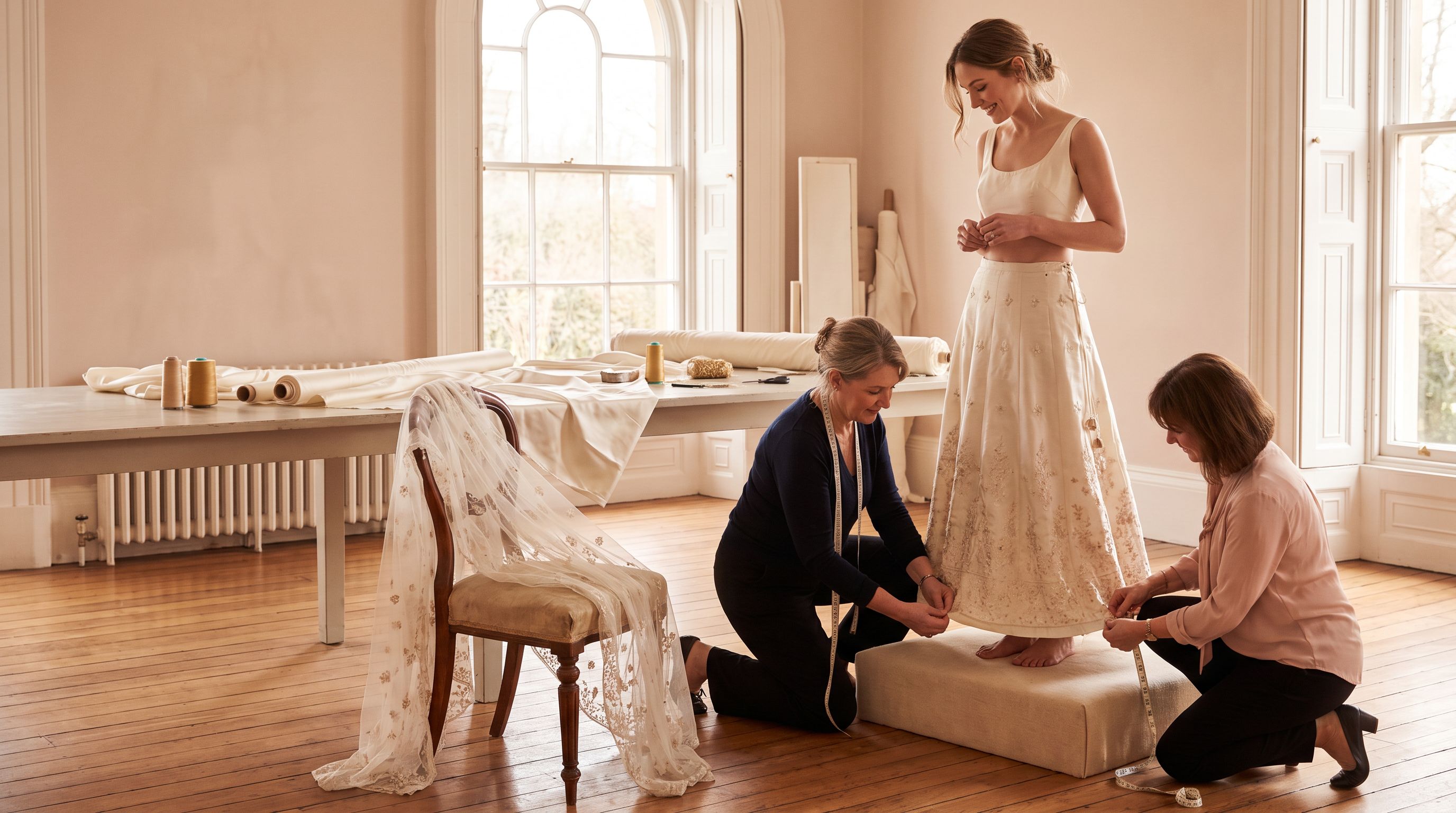
If your wedding brings together two cultures, one of the earliest and most emotional decisions you’ll make is what you wear — and how many times you change. It’s also a decision the bridal industry handles badly. Walk into most salons and you’ll find racks of white gowns; walk into a traditional bridal boutique and you’ll find gorgeous ready-made pieces sized to a chart that may or may not match your body. Neither shop is set up to make the thing in your head, which is often a hybrid of both.
That’s exactly what custom is for. Fusion bridalwear is also more visible than it has ever been: the major bridal and fashion titles now run real weddings where a white lehenga walks into a European church, where a hanbok and a tuxedo share a receiving line, or where South Indian, West African and Black American traditions shape a single day between them. What that coverage shows isn’t a specific look to copy — it’s permission to stop choosing.
What “fusion” actually means once a dressmaker is holding the pencil
When you sit down for a consultation, “fusion” needs to become specific. In practice, most commissions land in one of four places:
- A Western silhouette in traditional textiles. A ballgown or A-line built from Banarasi silk, kente, ikat, or an obi-weight brocade. The shape reads bridal-Western; the fabric carries the heritage.
- A traditional garment in bridal colors. A lehenga, hanbok, cheongsam, or áo dài executed in ivory, champagne, or blush rather than red, gold, or green — a choice that can be quietly radical in some families and completely unremarkable in others.
- A hybrid construction. A fitted corseted bodice with a lehenga skirt; a gown with a pre-draped saree pallu built in; a fishtail skirt with a detachable dupatta anchored at the shoulder.
- Two complete looks for two ceremonies or two halves of one day.
One look or two? The question that sets your whole budget
If you’re leaning toward two, it’s worth reading our breakdown of convertible gowns versus a separate second dress — the math there applies almost directly to a ceremony-and-reception cultural split.
Where the money actually goes
Here’s the honest headline: in fusion bridalwear, fabric is rarely the expensive part. Labor is. A yard of beautiful silk is a known quantity. Hand aari work is not — a densely embroidered piece can run into the hundreds of hours, and that number is what your quote is really made of.
The drivers you can actually control:
- Embroidery density and technique. Scattered motifs cost a fraction of an all-over embellished surface. Machine embroidery, sequin-on-net, and appliqué sit far below hand zardozi, dabka, or French beading. Ask for a quote at two densities and compare.
- Structure. A boned, lined, internally-supported bodice takes real pattern-making skill and adds hours. A simple choli or a soft unlined bodice does not.
- Fabric weight and behavior. Heavy brocade needs interlining and reinforced seams. Fine tulle and chiffon need hand-rolled hems and more finishing time. Both cost more than a stable crepe — worth understanding alongside our wedding dress fabric guide.
- Where the work happens. Commissioning through an atelier in South Asia, West Africa, or East Asia often buys you extraordinary hand-work for less than a Western studio can offer. Weigh the full picture before you assume it’s cheaper: remote fittings, shipping risk, import duty and customs handling on arrival, and the cost of local alterations once the garment lands — which can be several hundred dollars on a beaded piece. Ask, too, who actually does the embroidery and how those artisans are paid; a maker proud of their workshop will tell you plainly, and that answer belongs in a conversation about hand labor.
- Sleeves and coverage. Full sleeves, high necks, and lined bodices add fabric and construction time. If coverage matters for faith or family, our guide to modest custom gowns walks through what each option costs.
The question isn’t “how much does a custom fusion dress cost” — it’s “how many hours of hand-work am I buying, and could a lighter design give me 80% of the effect?”
Why embroidery changes your calendar
A plain silk gown can be cut, fitted, and finished in a few concentrated weeks. Embroidered panels are different: on many traditional pieces, the surface work is done before the garment is assembled, on flat panels, sometimes by a separate workshop.
That sequencing has a consequence most people don’t expect — your measurements get locked in early. Once panels are embroidered to a specific pattern shape, the seam allowance available for later adjustment is limited, especially through a beaded waistline.
This is also where it pays to ask about size range directly. Boned bodices and pre-embroidered panels are the least forgiving part of bridalwear, so ask your maker what sizes they regularly build, whether they’ve fitted a body like yours, and how they handle a fuller bust, a broader back, or a soft midline within a structured shape. If your measurements may shift before the wedding — for any reason at all — ask for generous seam allowance and an unbeaded adjustment zone to be built in from the start. Good makers plan for change rather than hoping against it.
Build in a toile (muslin) fitting before any embroidery is commissioned. It’s the single best money you’ll spend. For a fuller picture of the sequence, see how long a custom gown really takes.
Finding a maker who can genuinely do both
-
Decide which tradition drives the structure
If the garment is fundamentally a corseted gown with traditional fabric, lead with a Western-trained dressmaker. If it’s fundamentally a lehenga or a drape, lead with a maker who builds them regularly. The structural expertise should sit with the primary maker. -
Ask for work in your specific hybrid
”Have you built a bodice with a lehenga skirt before?” beats “do you do fusion?” Ask to see photos of the inside — seam finishing, boning channels, how a dupatta is anchored. -
Discuss color honestly
Ivory embroidery on ivory reads very differently in photos than gold on red, and both read differently against different skin tones. Ask for a stitched swatch in your actual colorway before committing, not a rendering. -
Confirm who handles the second look
If you’re doing two garments with two makers, agree early on who owns the fit standard — and share one set of measurements taken by one person. -
Get the payment and revision terms in writing
Deposit, embroidery approval point, how many fittings are included, what happens if the embroidered panel arrives wrong.
Using an heirloom saree, dupatta, or lace
Many fusion commissions start with something already in the family: a mother’s wedding saree, a grandmother’s veil, a length of cloth carried across a migration. Most of the time some part of it can live in the finished garment — as a bodice overlay, a dupatta, a lining, a hem band, a hidden panel over the heart.
What a good maker will check first: fiber strength (old silk can shatter along fold lines), color stability, and whether there’s enough usable yardage once damaged sections are cut away. Expect a candid conversation, and expect the answer to sometimes be “we use it as an accent, not the whole dress.”
If you’re at the stage of wanting to describe your vision to someone who can price it properly, a consultation with a dressmaker who has built hybrid garments before is a sensible next step. Bring the vocabulary, bring the heirloom, and bring your questions — the right maker will be delighted by all three.
Ready to bring your dream dress to life?
Tell us what you're picturing — style, timeline, and budget — and we'll connect you with custom dressmakers who can make it. Free, no obligation.
Get matched with a dressmakerRelated guides
Off the Rack Wedding Dresses: What It Means and Costs
What "off the rack" really means in bridal, how off-the-rack wedding dress costs compare to custom and made-to-measure, and how to set a realistic budget.
Read guide →
Chapel vs Cathedral Train: Length, Cost, and Bustles
Chapel vs cathedral train for a custom wedding dress: real length measurements, what extra train costs, bustle types and prices, and how to decide at your fitting.
Read guide →
Bridal Sizing vs Street Size: Why Gowns Run Small
Bridal sizing vs street size explained: why wedding dresses run 2–3 sizes small, what off-the-rack really means, alteration costs, and when made-to-measure wins.
Read guide →