 Custom
Couture Label vs Custom Dressmaker: What You Pay For
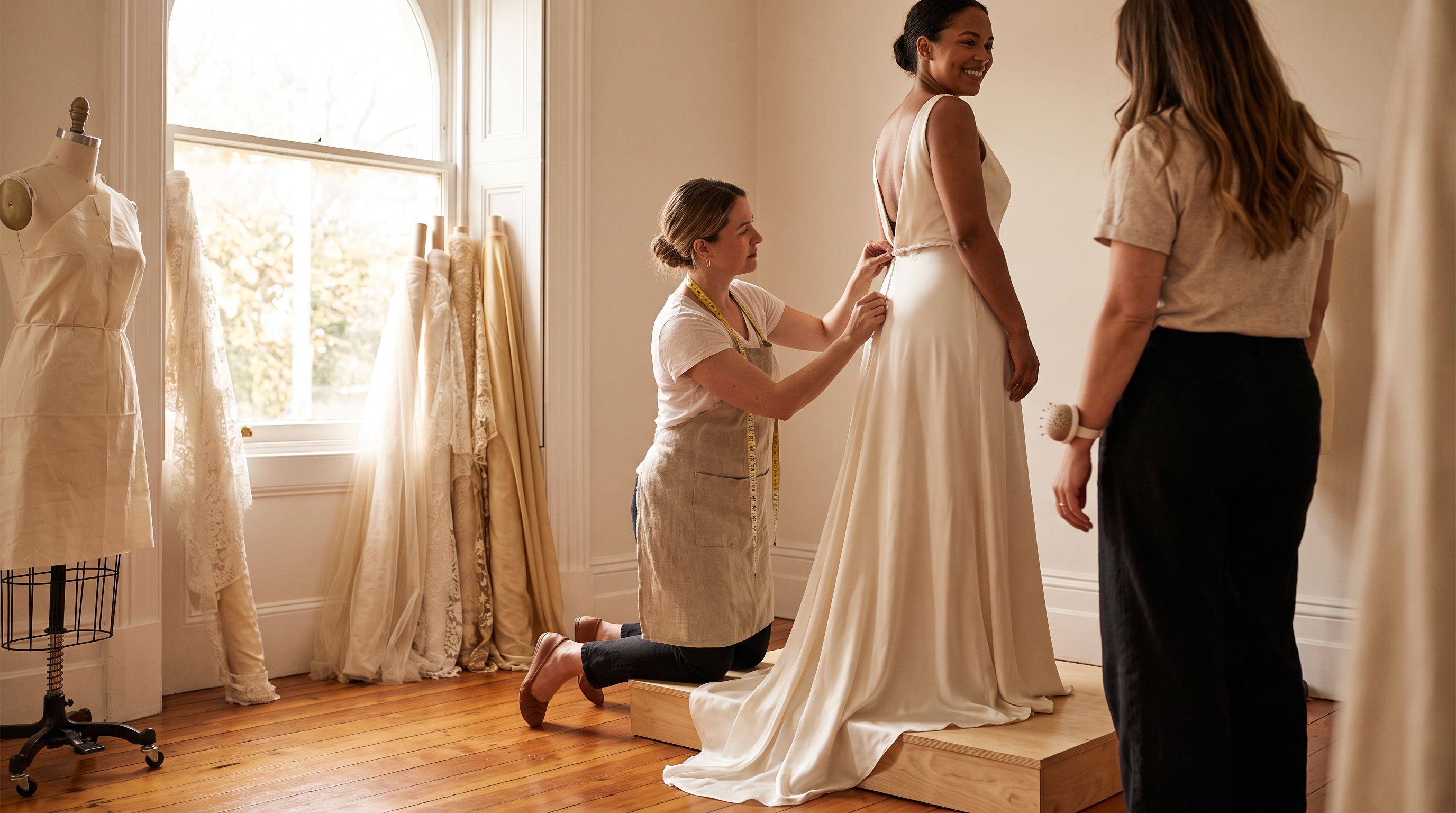
You know the gown. It’s in your saved folder — a cathedral-length illusion back, a liquid silk skirt, lace that looks like frost. Then you find the price, and it’s more than your catering deposit. The question that follows is almost always the same: could someone just make me that?
It’s a fair question, and the honest answer is more interesting than yes or no. Let’s take apart what a couture label actually charges for, what an independent custom dressmaker charges for, and how to tell which one your particular dress belongs to.
What “couture” really means on a bridal price tag
In the strictest sense, haute couture is a protected French designation with legal requirements about ateliers, staff, and made-to-measure production. In bridal, the word has loosened. It gets used for three very different things:
- Designer made-to-order. You try a sample at a salon, order your size in the house’s standard measurements, and it’s cut and sewn for you — then altered locally. This is most of what’s called “couture” in bridal shops.
- Designer made-to-measure. The house takes your measurements and adjusts their existing pattern. Closer to true custom, usually a surcharge on top of the base price.
- Genuine atelier couture. An original design, a personal pattern, multiple fittings at the house, specialist hand embroidery. Rare, slow, and priced accordingly.
Knowing which one you’re being quoted changes everything about the value. If the distinction feels blurry, our breakdown of semi-custom, made-to-measure, and bespoke terminology is worth ten minutes before you walk into any appointment.
Where the money goes in a designer gown
A designer price is a stack, and only part of it is sewing. You’re paying for design and pattern development, sample production, showroom and trunk-show costs, the salon’s margin, marketing, the house’s fabric relationships, and — genuinely — the engineered interior. A well-built designer bodice has a boned corselette, bias-cut linings, horsehair hems, and a construction logic refined over many seasons and many bodies.
You’re also paying for exclusivity. Some mills sell certain laces or silks only to specific houses. If you’ve fallen for a particular Alençon motif or a hand-degradé beaded tulle, there may genuinely be no open-market equivalent, only a cousin.
Where the money goes with an independent maker
With a custom dressmaker, the stack is shorter: fabric and notions, pattern drafting, a toile (the test garment in cheap cotton), construction hours, fittings, and the maker’s expertise and overhead. No showroom markup, no seasonal collection to fund.
That’s why custom often lands below designer retail for similar quality — not because corners are cut, but because fewer people take a slice. Fabric alone tells the story: silk duchesse satin commonly runs roughly $40–$120 per yard, French laces can start near $60 and climb past $300 per yard, and a gown may take 5–12 yards plus lining. A heavily hand-beaded bodice can absorb 40–100+ hours of labor by itself, which is exactly why beading is the fastest way to move a quote. Our full cost breakdown walks through each driver.
To be plain about it: these three ranges are our editorial estimates based on openly published salon and maker pricing, not survey data. Use them as a starting frame and adjust for your fabrics, your embellishment, and your city.
So is custom actually cheaper?
Usually, yes — against designer retail, at the same quality of fabric and finish. But “cheaper” isn’t automatic, and anyone who promises it is overselling.
Custom tends to win when your body needs real pattern work (a significant bust-to-waist difference, petite or tall proportions, asymmetry, a size outside a designer’s range), when you want something that doesn’t exist off a rack, or when alterations on a stock gown would be extensive. Off-the-rack or sample can win when you find a gown you love that already fits close to your frame — a straightforward hem and side seams on a sale gown is almost always the cheapest path to beautiful. We’ve done the side-by-side math in custom vs off-the-rack wedding dress cost.
Custom also wins whenever the gown you need isn’t the gown the bridal market is built around. Red, gold, or fully non-white dresses; a lehenga- or qipao-influenced silhouette; a second and third look for a tea ceremony, sangeet, or reception that should coordinate without repeating; sleeves and high necklines for a church, mosque, synagogue, or temple; a detachable overlay so one dress can move from a covered ceremony to a dancing reception. Mainstream bridal stock still skews heavily toward strapless ivory, and alterations can only carry a pattern so far from what it was cut to be.
One number people forget: alterations on a designer gown commonly run several hundred to well over a thousand dollars, and they are not usually included in the ticket price. With custom, fittings are typically built into the quote. Compare total landed cost, not sticker to sticker.
A designer price tag buys a point of view. A custom price tag buys hours. Decide which one your dress actually needs.
Can a dressmaker recreate the gown you saved?
Partly — and the honest makers will tell you exactly where the line is. A skilled custom dressmaker can match a silhouette, a neckline, a sleeve shape, a train length, and the general feel of a fabric with real accuracy. What they generally can’t do is source a house-exclusive lace, replicate couture hand-embroidery hour-for-hour at a third of the price, or copy a protected design line-for-line (reputable makers won’t, and you don’t want a maker who will).
The better conversation is: what are the three things I love most about this photo? The neckline, the fabric movement, and the back — not every bead. That reframing is where custom genuinely outperforms.
How to choose with confidence
-
Name what you're buying
If you’re in love with a specific designer’s signature — their lace, their aesthetic — buy the designer. If you’re in love with a feeling you can’t find in stock, go custom. -
Price the whole path
Add alterations, a veil or cape, undergarments, pressing, and shipping to each option. Compare final numbers. -
Check the calendar
Designer made-to-order often needs 6–9 months plus alterations. Custom typically wants 6–9 months too, with 4–5 months workable and rush fees above that. -
Look at real finished work
Ask any maker for photos of completed gowns on clients, not just flat-lays — and ideally on bodies like yours. Then ask what’s inside: lining, boning, hem finish. -
Get the quote in writing
Itemized fabric, labor, number of fittings, what a change order costs, and the payment schedule.
There’s no wrong answer here — plenty of clients are happiest in a designer gown they tried on and immediately loved, and plenty are happiest in something that existed only as a sketch until a maker drafted it to their measurements. If you’re leaning designer, book two salon appointments in different price tiers before you decide; seeing a $3,000 gown and an $8,000 gown in the same week shows you the difference in a way photos never will. If you’re leaning custom, bring your photos, your date, and your honest budget number to a consultation and let a maker tell you what’s realistic. Either way, the people worth your money will be straight with you before you’ve spent a dollar.
Ready to bring your dream dress to life?
Tell us what you're picturing — style, timeline, and budget — and we'll connect you with custom dressmakers who can make it. Free, no obligation.
Get matched with a dressmakerRelated guides
Getting a Wedding Dress Made Abroad: Is It Worth It?
Thinking of having your wedding dress tailored in Bangkok, Hoi An or Bali? Real costs, timelines, risks and how it compares to a custom dressmaker at home.
Read guide →
Bought a Wedding Dress Online? Alter, Remake, or Custom
Your online wedding dress arrived and the fit is wrong. Here's how to tell what's fixable, what alterations cost, and when going custom is the smarter buy.
Read guide →
Custom Veil vs Heirloom Veil: Cost, Length, and Fit
What a custom wedding veil costs, how to choose a length, and when wearing (or restoring) an heirloom veil is the smarter, more meaningful choice.
Read guide →