 Custom
Your First Custom Dressmaker Consultation: What to Bring
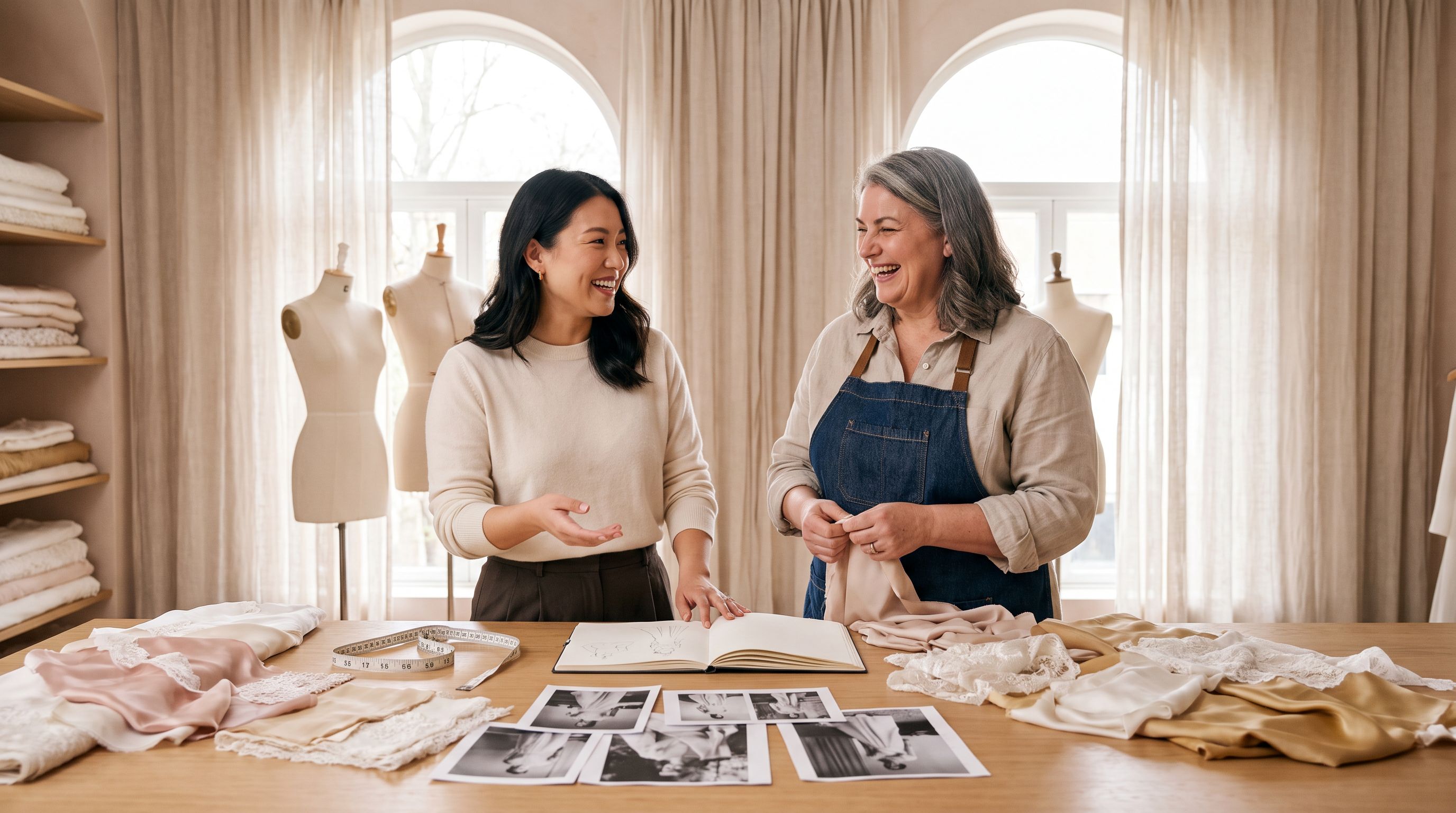
What actually happens in that first appointment
If you’ve only ever been to a bridal salon, a dressmaker’s consultation can feel unfamiliar — because you’re not trying on a rack of samples. You’re having a design conversation.
That difference matters more than it sounds. A salon fits you into the nearest sample size and alters inward; a dressmaker drafts a pattern from your own measurements, which is the single biggest reason people go custom in the first place. It’s also why the conversation isn’t limited to gowns. If what you actually want is a tailored suit, a two-piece with a separate skirt and top, a jumpsuit, or a ceremony look with a second outfit for the reception, say so in the first ten minutes — most makers work across all of it.
Most first appointments follow a similar rhythm. You talk about your wedding: the date, the venue, the weather, how formal it is, how you want to feel. You show your inspiration images. The maker asks questions you may not have considered — how you plan to move, whether you’ll be dancing hard, whether you need sleeves, whether anyone in your family has expectations about coverage. They’ll show you fabric swatches and let you handle them, which is the part most people underestimate. Then they’ll usually take a quick set of measurements (over clothes is fine at this stage) and talk through a ballpark price and timeline.
You should leave with a clear sense of three things: what the maker thinks they’d build for you, roughly what it would cost, and how long it would take.
What to bring, and why each thing matters
-
Inspiration photos — including the ones you don't like
Save 10–20 images, not 100. Then add three or four looks you actively dislike. Knowing you hate strapless necklines or heavy beading narrows a design faster than another pretty pin. If a single photo is the photo, say so clearly and ask directly what can and can’t be replicated in your fabric and budget.
-
Your shoes — or a close stand-in
Hem length is set from your shoe height. Bring the heels you intend to wear, or the flats, or the sneakers. If you haven’t bought them, bring something the same height and tell the maker your plan.
-
The undergarments you'll actually wear
A bra that fits, shapewear if you’ll use it, or nothing at all if you’re hoping for built-in support. This genuinely changes the design conversation — a bodice with internal structure is drafted differently from one worn over a bra.
-
A real budget number
Not a vague one. The single most useful sentence you can say is: “I’d like to stay under $X all in, including alterations.” It isn’t rude. It lets a good maker design toward your number instead of wasting both your time.
-
Wedding logistics
Date, venue, indoor or outdoor, season, expected temperature, whether there’s a religious ceremony with dress requirements, whether you’re traveling with the garment, and whether there’s a dance floor you intend to destroy.
-
Anything sentimental
Your mother’s veil, grandmother’s lace, a piece of a sari or ao dai, a brooch, a handkerchief. Bring the actual object if you can — a maker needs to see and touch old fabric to know whether it will survive being sewn into something new.
-
One trusted person (two at most)
Choose the person who makes you feel more like yourself, not less. Large opinionated groups work against a consultation that’s mostly conversation.
How to talk about money without the awkwardness
This is the part people dread, and it shouldn’t be. Custom pricing isn’t one number — it’s a stack of decisions. Fabric quality, how much fabric the silhouette eats, hand-beading or appliqué, lining and internal structure, train length, and the maker’s experience and location all move the total. The same design in polyester crepe versus silk duchesse can differ by a thousand dollars in materials alone. If you’d like a realistic frame before you walk in, our breakdown of what a custom wedding dress typically costs and what drives the price lays out the drivers.
A good maker will respond to your budget by telling you what’s achievable at that level and what would have to change. “At that number I’d suggest a lace bodice with beading at the neckline only rather than all over” is a sign of a professional. Vagueness — “let’s talk about it later” — is not.
And if your number is genuinely below what a from-scratch piece costs in your area, that’s useful information, not a dead end. Ask about semi-custom (a maker’s existing design adapted in fabric, neckline, or sleeve) or made-to-measure from a pattern they already own — both skip the costly drafting stage while still being cut to your measurements. A third route is buying a simple off-the-rack gown and paying a skilled seamstress to substantially rework it: new sleeves, a changed back, a reshaped neckline. Many makers do this work happily and will tell you honestly which route gets you closest to your photo.
A maker who asks about your budget in the first ten minutes isn’t being pushy. They’re being honest about the fact that fabric has a price.
The questions that tell you the most
Ask these, and listen to how they’re answered as much as to the answers themselves:
- How many fittings do you include, and what happens if we need more?
- Do you make a toile (muslin) first, and is it included?
- What’s your deposit, your payment schedule, and your policy if my body changes before the wedding?
- Who does the final alterations — you, or someone else?
- May I see photos of finished work on real clients, not just dress forms?
- Have you made this kind of construction before? (Corsetry, sleeves, a heavily beaded bodice, trousers, seated fit, nursing access — whatever applies to you.)
- What’s the latest date you’d take an order for my wedding day?
The fittings answer matters more than people expect; our guide to how many fittings a custom gown typically needs explains what a normal schedule looks like and when extra appointments are reasonable.
In person or virtual: both can work
If there’s no dressmaker within a reasonable drive of you, a remote maker with a disciplined toile process is a legitimate path — it just requires more documentation and a longer runway.
What happens after you leave
Typically: a written quote, sometimes a sketch, and a proposed schedule. If you proceed, a deposit secures your slot in the maker’s calendar, full measurements are taken, fabric is ordered, and a toile is cut. From there you’re into fittings, each one refining the fit closer to your body.
If your runway is short — under about four months — ask what that practically changes. Usually it means fewer fittings, fabric chosen from what’s in stock or available quickly rather than ordered in, simpler beading or none, and often a rush fee. Plenty of makers do excellent work on a tight timeline; you just want to hear those trade-offs named out loud before you commit, not discovered at the second fitting.
Most makers offer that first conversation free and with no obligation precisely because it’s as much an interview of them as of you. Come with your photos, your shoes, and your honest number, and you’ll learn more in ninety minutes than in weeks of scrolling.
Ready to bring your dream dress to life?
Tell us what you're picturing — style, timeline, and budget — and we'll connect you with custom dressmakers who can make it. Free, no obligation.
Get matched with a dressmakerRelated guides
Bridal Seamstress vs Regular Tailor: Who to Trust
Can a regular tailor alter a wedding dress? Here's how a bridal seamstress differs, what each job costs, and when to hire a custom dressmaker instead.
Read guide →
Church Wedding Dress Code: Shoulders, Sleeves, Coverage
Does your church require covered shoulders? Here's how to confirm the dress code and design a custom wedding dress with sleeves, a cape, or removable coverage.
Read guide →
Custom Wedding Dress After a Mastectomy: Fit & Support
A practical guide to a custom wedding dress after mastectomy or breast surgery: prosthesis pockets, support without underwire, scar coverage, timing, and real costs.
Read guide →