 Custom
 Is It Cheaper to Make Your Own Wedding Dress?
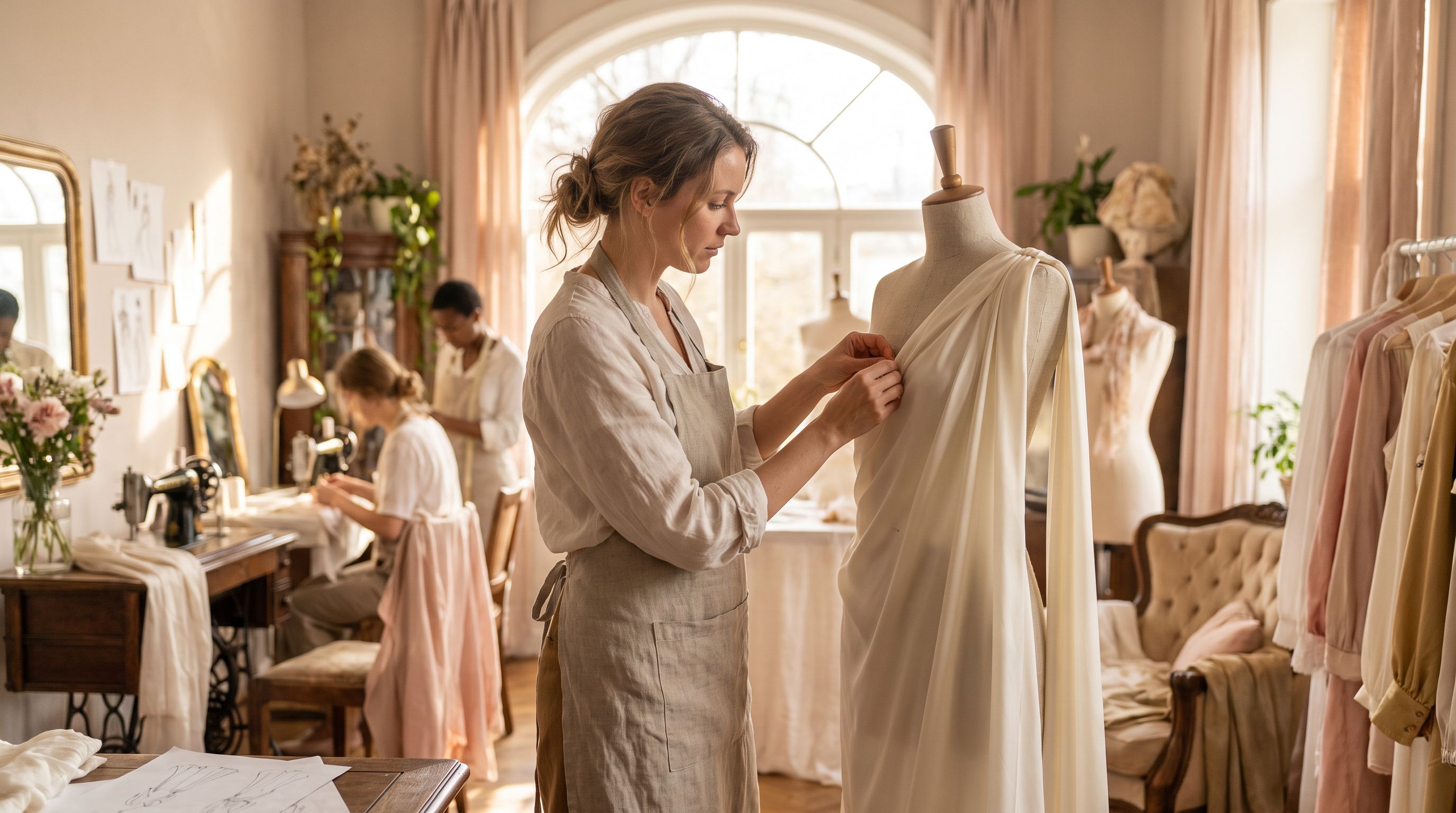
This question comes up constantly, usually from someone who sews well enough to make a shift dress and has just seen a bridal price tag for the first time. It’s a fair question, and the honest answer is: sometimes yes, sometimes no, and the gap is smaller than the internet suggests.
One honest gate before the math: the realistic skill floor for a DIY gown is being confident sewing a fitted, lined bodice and inserting an invisible zipper cleanly, unsupervised. If that sentence made you wince — or if your months are already full — you’re not out of options; skip to the hybrid section below, or look at off-the-rack plus good alterations, which is often the cheapest well-fitting route of all.
What the materials really cost
A wedding dress is not one fabric. It’s usually three or four layers plus structure, and each one has a price.
Here’s what you’re buying, roughly, in general terms — prices vary enormously by country, supplier, and whether you catch a sale:
- Outer fabric. Polyester satin or crepe is the budget end. Silk crepe, silk mikado, silk charmeuse and duchesse satin cost several times more per yard. Good French or Italian beaded lace is in a category of its own — a single yard can cost more than an entire polyester gown.
- Yardage. A simple slip gown might take 4–6 yards; add a train, a full skirt, ruffles, or bias cutting (which eats fabric) and you can be at 10–15 yards fast. Treat those as a starting point, not a rule: fabric requirements rise with height, bust and hip circumference, and cup size, and a longer torso or a fuller skirt sweep can add yards on its own. Note too that many commercial bridal patterns stop well short of extended sizes, so budget for grading up, a pattern explicitly drafted across your size range, or a block drafted to your measurements.
- Lining and underlining. Almost always silk habotai, crepe de chine, or a good poly lining. That’s a second fabric bill.
- Structure. Boning, cups, power mesh, horsehair braid, interfacing, an invisible zipper or a strip of covered buttons and loops. Individually cheap, collectively not.
- Toile fabric. You will need at least one, realistically two or three mock-ups in cheap muslin or cotton before you cut into your good fabric. Budget for it.
- Pattern, tools, and the dress form. A pattern, a rotary cutter, silk pins, a walking foot, possibly a dress form padded to your measurements.
Those numbers are meant to be adapted, not copied. Price your actual fabric, in your actual yardage, before you decide anything. A single afternoon on fabric supplier sites will tell you more than any article.
If your wedding outfit isn’t a white gown
Plenty of readers are planning a lehenga, a hanbok, a cheongsam, an áo dài, a suit, separates, or two outfits across a multi-day celebration. The cost logic above still holds — fabric, structure, hours, risk — but the risk curve is steeper. Heavily embellished, hand-worked or intricately draped traditional garments are generally a poor first DIY project: the embroidery, the pleating and the fit tolerances all reward specialist experience. The kinder plan is usually to commission or buy that piece from someone who works in that tradition, and to sew a simpler second look yourself — a reception dress, a slip, a jacket, a set of separates for the after-party.
The cost nobody puts in the spreadsheet
Hours. Bridal sewing is slow sewing. Silk shifts under the needle, chiffon frays looking at it, and a bodice that fits properly needs fitting on a live body — which means someone else pinning you, more than once.
Then there’s hand finishing: catch-stitching hems, hand-picking a zipper, tacking linings, sewing on buttons and loops. That’s evening after evening, in the same months you’re chasing a caterer and a seating chart.
And there’s risk. If you cut the silk wrong at week ten, you buy the silk again — or you don’t, and you make peace with a dress you didn’t want. A professional carries that risk for you; it’s baked into their price.
Sewing your own gown isn’t really a money decision. It’s a decision about where you want to spend the last three months before your wedding.
How the two paths actually compare
What a custom maker is charging you for
When you see a made-to-measure quote, the fabric is often the smaller half of it. You’re paying for a pattern drafted to your measurements, one or more toiles, three to five fittings, internal construction you’ll never see, and the maker’s judgment about what will actually work on your frame.
Custom gowns commonly run from around the low four figures for a clean, unadorned design up through several thousand for structured or embellished work, with heavily beaded couture-level pieces well beyond that. Fabric choice, beading, boning and corsetry, the maker’s experience, and your city all move the number. We break the drivers down in detail in our guide to what a custom wedding dress costs.
Here’s the part worth sitting with: if you were planning a silk-and-lace DIY gown, your materials bill may already be close to the low end of a simple made-to-measure quote. At that point you’re spending 100 hours to save a few hundred dollars.
Setting a wedding dress budget that holds up
A realistic dress budget is not one number — it’s the gown plus everything that makes the gown work.
A useful way to decide the ceiling: pick a number you can pay without resentment, then ask what that number buys in each of the three routes — off-the-rack plus alterations, custom, or DIY. If custom is within reach, it often wins on fit alone. If it isn’t, our honest comparison of custom versus off-the-rack versus alterations will help you weigh it.
The middle path most people miss
You don’t have to choose all-or-nothing. Some of the happiest outcomes are hybrids:
-
Sew the simple layer, buy the hard one
Make a clean bias slip yourself and commission or buy a lace overlay, jacket or overskirt. The structured, high-risk piece goes to a professional. -
Hire out the fitting, sew the rest
Pay a dressmaker for a fitted bodice block drafted to your measurements, then build the skirt yourself from that pattern. -
Do the embellishment by hand
Have the gown made plain and add your own beading, appliqué, or an embroidered hem with a meaningful date or motif. Deeply personal, low risk. -
Sew a second look
Make the reception dress or the after-party slip yourself, and let the ceremony outfit be professional work.
Give yourself an honest deadline
Whichever way you go, time is the constraint that bites. A DIY gown needs a hard cut-off — fabric bought and toile fitted several months out, finished at least four to six weeks before the wedding, so a professional can rescue or alter it if needed. Professional custom work has its own rhythm of consultation, toile and fittings; the realistic timeline for a custom gown is worth reading before you set your plan.
If you do go looking, ask to see gowns they’ve made from scratch rather than altered, ask how many fittings are included and what happens if your measurements change, ask who owns the toile stage decisions, and ask for the whole scope in writing before any deposit. A maker who answers those calmly and specifically is showing you exactly how the process will feel later.
And if you sew it yourself? Do it with your eyes open, start early, and enjoy it. There’s nothing quite like walking down the aisle in something your own hands made — as long as the making was joy and not panic.
Ready to bring your dream dress to life?
Tell us what you're picturing — style, timeline, and budget — and we'll connect you with custom dressmakers who can make it. Free, no obligation.
Get matched with a dressmakerRelated guides
Wedding Dress Budget: The Hidden Costs Beyond the Gown
A realistic wedding dress budget includes more than the gown. Here's what alterations, undergarments, veils, rush fees and cleaning really cost — custom or off-the-rack.
Read guide →
Beaded Wedding Dress Cost: Hand-Beading vs Appliqué
What beading really adds to a custom wedding dress cost — hand-beading vs beaded lace appliqué vs pre-beaded fabric, with realistic price ranges and cost drivers.
Read guide →
Silk vs Polyester Wedding Dress: Is Silk Worth the Cost?
Silk vs polyester wedding dress fabric, honestly compared: real price ranges per yard, how much fabric a gown needs, drape, sweat marks, and when to splurge.
Read guide →