 Custom
 2026 Custom Wedding Dress Trends (And What They Cost)
This guide was last reviewed in January 2026. We say “bride” for brevity — everything here applies equally to grooms, non-binary and trans clients, and anyone else commissioning a gown.
What’s shaping bridal as of early 2026
Three threads are running through the trend coverage. Who What Wear, in its January 2026 Copenhagen Fashion Week round-up, flagged sheer, slinky, barely-there dressing heading straight for bridal. Monsoon’s own 2026 bridal trend guide, published in December 2025, leans the other way — sleeves, capes and coverage. And Reuters reported in late 2025 that bridal designers and retailers say they are bracing for a wave of Taylor Swift–inspired requests once a high-profile dress is revealed.
To be clear about what’s reported and what isn’t: the Reuters piece is brands publicly saying they expect a rush. Whether that actually stretches your maker’s calendar is our inference — but it’s a reasonable one, because when a look goes viral, sample rails get booked out and popular fabrics sell through. A good independent dressmaker isn’t immune to that either, but they start from your measurements, your fabric and your comfort level rather than a size chart.
Sheer panels and illusion: gorgeous, and quietly technical
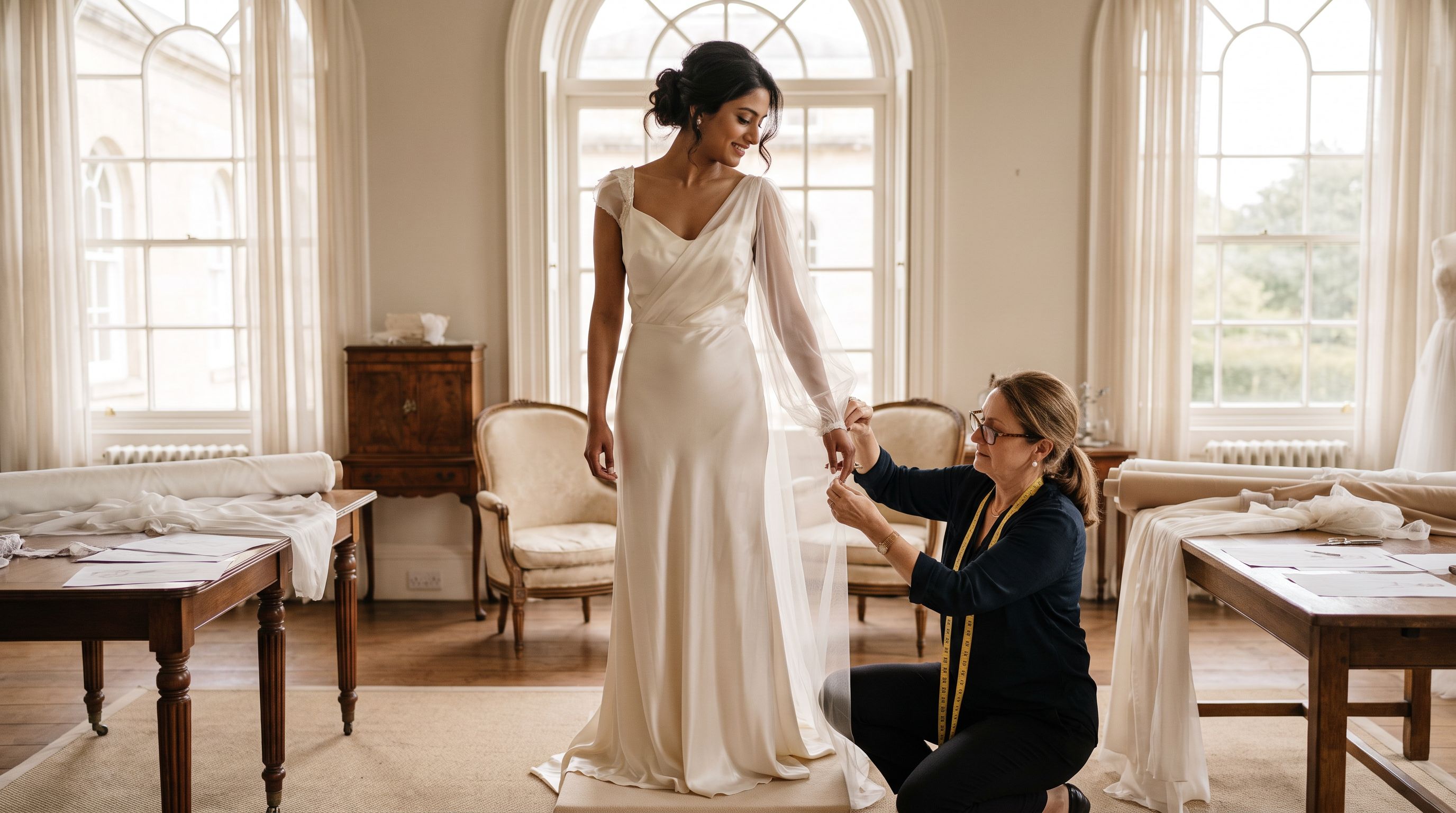
Sheer is the headline trend, and the one clients most often underestimate. A sheer bodice, illusion side panels or a barely-there overlay isn’t “less dress” — it’s usually more work. Everything under and behind that fabric becomes visible, so seams have to be French-finished or hand-rolled, boning has to be encased and placed where it won’t shadow through, and the internal structure has to hold the gown up without a wide bra band.
That’s where made-to-measure earns its money. A skilled maker builds an internal corselette — a hidden, boned inner bodice fitted to your ribcage — so a strapless or open-back sheer gown stays put through dancing without digging in. Off the rack, that structure is engineered for an average torso length. If you’re petite, or long through the waist, or tall with a short rise, it can sit two inches wrong and no alteration fixes it without rebuilding the bodice.
Sleeves, coverage, and the modesty brief
The other loud trend for 2026 is coverage: long fitted sleeves, detachable capes and overskirts, high necks, dropped-shoulder portrait necklines. Good news if you want sleeves for style, for warmth, for a religious or cultural standard, or simply because you’d rather not tug at a strapless bodice all evening.
Say what you need in the first ten minutes. A hijab-compatible neckline that sits cleanly under a scarf, elbow or wrist coverage and an opaque lining for tznius standards, a lehenga- or hanbok-influenced silhouette, a red or gold gown instead of white, a back closure that doesn’t gape — these are design parameters, not compromises. Any experienced maker will respond with construction ideas (a bonded sleeve seam, a hooked-in modesty panel, a separate blouse-and-skirt build) rather than talking you out of it.
Sleeves and coverage are also the most common reason people go custom at all, because armholes are where ready-to-wear fails hardest. But the list is longer than that. Custom genuinely solves: fuller arms and broader shoulders that ready-made sleeve caps bind across; plus sizes above a standard bridal 20, where graded patterns stop matching real proportions; asymmetry after mastectomy or reconstruction, including internal pockets for a prosthesis; seated wearers, who need a flat back seam, no bulk at the hips and a hem that reads correctly from the front while sitting; and pregnancy or nursing, where discreet front access and adjustable lacing matter more than the sketch does.
Coastal, seasonal fabrics and the destination question
Savannah Magazine’s November 2025 look at Southern coastal wedding trends for 2026 points at something many of us are seeing: lighter, more relaxed gowns for humid outdoor settings. Fabric is doing most of that work.
If you’re marrying abroad, say so early: fabric weight, packability and a hem finish that survives sand or grass get decided at the design stage, not the final fitting.
What these trends cost when they’re made for you
Custom pricing is genuinely variable — fabric, hand-work, your maker’s experience and your region all move it. A dressmaker in a small town and an atelier in New York or Atlanta run very different overheads. Treat these as illustrative starting points and get real quotes.
The drivers are easy to reason about: metres of fabric (a full skirt or cathedral train eats yardage), hand-work hours, number of pattern pieces, how many fittings the design needs, and whether you’re in luxury silk or a good synthetic.
If full custom is out of reach, you still have real options. A simple unlined crepe slip or a two-piece skirt-and-top, made locally with no beading and one fitting, can land well under a thousand dollars in many areas — ask for exactly that, rather than a scaled-down version of a complex gown. A sample-sale or preloved gown plus a genuinely skilled alterations tailor often gets you closer to a couture fit than a cheap new dress will. And renting a simple base gown while commissioning only the detachable pieces — sleeves, a cape, an overskirt — puts the custom money where it shows.
A trend costs what it costs to build. Sheer isn’t cheaper because there’s less fabric; you’re paying for the seams you can see through. Our full breakdown of what drives a custom wedding dress cost walks through each line item.
Timing: why this year’s rush should move your deadline up
Two different numbers get quoted, so here’s the distinction. Most independent makers want six to nine months from signed contract to delivery for a from-scratch gown, with heavily embellished or sheer designs at the longer end. The 9–12 months below is consultation-to-wedding — it includes the weeks you’ll spend meeting makers, comparing quotes and deciding. Rush work is often possible at a premium, but it removes your safety margin if a fabric is back-ordered.
-
9–12 months out: consultation and design
Bring 5–10 images, not one. Discuss budget openly, choose fabric, agree a sketch and a payment schedule in writing. -
6–8 months out: measurements and toile
A muslin/toile is a test garment in cheap fabric. Necklines get raised, sleeves get eased, and the silhouette proves itself before anyone cuts silk. -
3–5 months out: first fitting in real fabric
Bring your actual shoes and undergarments. Expect pins, chalk, and a gown that still looks unfinished — that’s normal. -
6–10 weeks out: second and third fittings
Refinements, hem, bustle, closures. Beading is usually applied after the fit is locked. -
2–4 weeks out: final fitting and handover
You should be able to sit, hug and dance in it. Ask for a bustle demo for whoever’s helping you dress.
If that makes you nervous, our guide to how long a custom wedding dress takes covers shorter runways and what’s realistic in three or four months.
Bringing a trend to your maker without losing yourself
The happiest clients arrive with a feeling rather than a single screenshot. Save necklines you love, backs you love and fabric movement you love — separately. Then let your maker tell you honestly which elements work together on your frame and which fight each other.
A maker who answers calmly and specifically — and who says “that detail won’t sit well on you, here’s what would” — is worth more than one who agrees with everything. If you’re weighing this against buying and altering a designer sample, our comparison of custom versus off-the-rack lays out when each genuinely wins.
To take the next practical step: gather your saved images, your budget ceiling, your date and venue, and the shoes and undergarments you expect to wear — that’s everything a first consultation needs. Find makers through local sewing or tailoring guild directories, alterations shops that draft their own patterns rather than only hemming, fabric stores that keep a maker list, and referrals from people married in the last year or two.
Ready to bring your dream dress to life?
Tell us what you're picturing — style, timeline, and budget — and we'll connect you with custom dressmakers who can make it. Free, no obligation.
Get matched with a dressmakerRelated guides
Custom Wedding Dress for Apple-Shaped Brides: Fit Guide
How a custom wedding dress solves fit for apple-shaped brides: the best silhouettes, internal support, fabrics, fittings, and realistic costs.
Read guide →
Custom Wedding Dress for a Small Bust: A Real Fit Guide
A custom wedding dress for a small bust: how bodices get cup-sized, strapless support without heavy padding, flattering necklines, and realistic cost ranges.
Read guide →
Custom Winter Wedding Dress: Fabric, Sleeves, Warmth
How to design a custom winter wedding dress that's genuinely warm: the best fabrics, sleeve and lining choices, capes, realistic costs, and timeline tips.
Read guide →